Go 1.27 Just Got SIMD (And Your Node.js Bottlenecks Should Notice)
There's a part of your MERN app you've probably made peace with — the slow part. The image processing route that chokes under load. The vector similarity search that takes 400ms. The CSV parser that blocks your event loop. You've thrown caching at it, maybe spun up a worker thread, and called it good enough. Go 1.27's new platform-independent SIMD support might be the actual fix you've been putting off.
This one's for the MERN devs who keep Golang in the back pocket but haven't had a clean excuse to reach for it. Today you do.
What SIMD Even Is (Quick Version)
SIMD stands for Single Instruction, Multiple Data. The short version: instead of adding two numbers at a time, your CPU can add eight pairs of numbers in a single clock cycle if you use SIMD instructions.
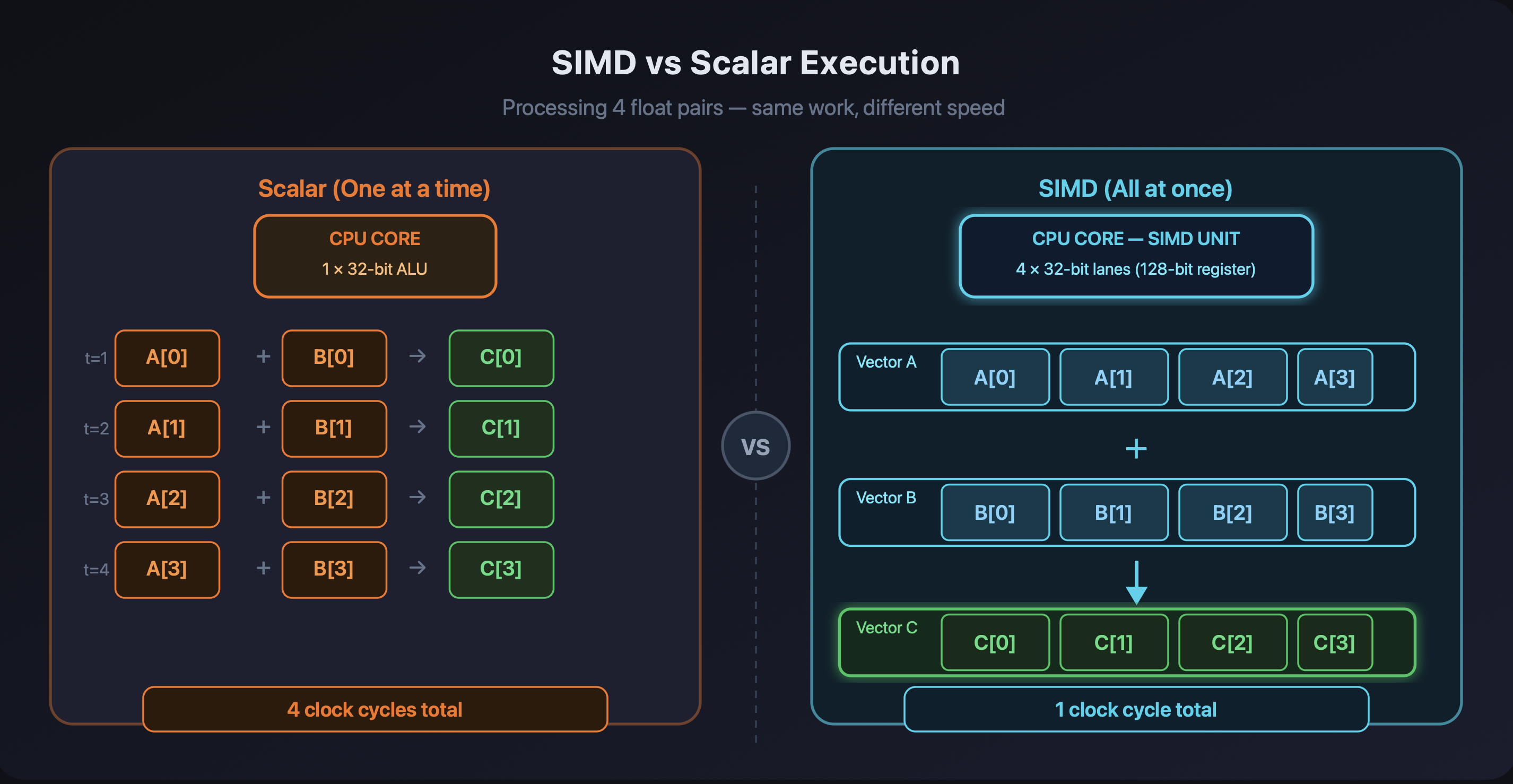
Your modern CPU — whether it's running AVX512 on an x86 server or NEON on an ARM machine — has these instructions baked in. The problem has always been that writing SIMD code meant picking your architecture and writing separate, platform-specific implementations. You'd write one version for amd64, another for arm64, and pray you never had to debug the wasm build.
Go 1.27 fixes this. The new simd package gives you a single, portable API that the compiler automatically translates to the best native instructions for whatever hardware you're running on — with automatic emulation fallbacks if the hardware doesn't support it.
What Go 1.27 Actually Added
The package introduces width-agnostic vector types like simd.Float32s and simd.Uint8s. You don't specify "256-bit vector" in your type — the runtime figures out the widest vector your CPU supports and uses it. You write the logic once.
Here's the canonical example from the Go team: computing an inner product (think dot product — used everywhere from recommendation systems to embedding similarity searches).
package main

import (
    "golang.org/x/exp/simd"
)

func innerProduct(x, y []float32) float32 {
    var a simd.Float32s
    var i int

    // Process full vector-width chunks
    for i = 0; i < len(x)-a.Len()+1; i += a.Len() {
        u := simd.LoadFloat32s(x[i : i+a.Len()])
        v := simd.LoadFloat32s(y[i : i+a.Len()])
        a = u.MulAdd(v, a)  // fused multiply-add — one instruction
    }

    // Handle the leftover tail
    if i < len(x) {
        u, _ := simd.LoadFloat32sPart(x[i:])
        v, _ := simd.LoadFloat32sPart(y[i:])
        a = u.MulAdd(v, a)
    }

    return sum(a)
}
The compiler generates @simd128, @simd256, and @simd512 variants automatically. At startup, Go detects your hardware and dispatches to the widest supported path. You can override this with GODEBUG=simd=0 (pure scalar, for benchmarking) or GODEBUG=simd=256 to pin a specific width.
The API covers arithmetic (Add, Multiply, MulAdd), comparisons, bitwise ops, masking, and type conversions. Notably, ReduceSum and horizontal reductions are missing in 1.27 but slated for 1.28 — something to keep in mind if you need aggregation.
Why a MERN Dev Should Care About This
Here's the honest truth: your Express.js API is probably fine for most of what it does. JSON in, JSON out, a MongoDB query in between — Node.js handles this beautifully and scales horizontally with zero drama. Don't rewrite your entire backend in Go because of a Hacker News post.
But there's a category of work that Node.js genuinely struggles with, and it's the exact category SIMD accelerates:
Vector similarity search — comparing embedding vectors for semantic search or recommendation engines
Image/video processing — pixel-level operations on buffers
ML inference preprocessing — normalizing and batching float arrays before sending to a model
Compression and checksums — anything that processes byte arrays in bulk
Parsing large datasets — CSV, binary protocols, log ingestion
These are CPU-bound tasks. Node.js's event loop wasn't designed for them, and worker_threads only does so much. A Go microservice running SIMD-accelerated code can do this work 5–10x faster and hand the result back to your Express layer via HTTP or a Unix socket.
The Pattern: MERN + Go Microservice
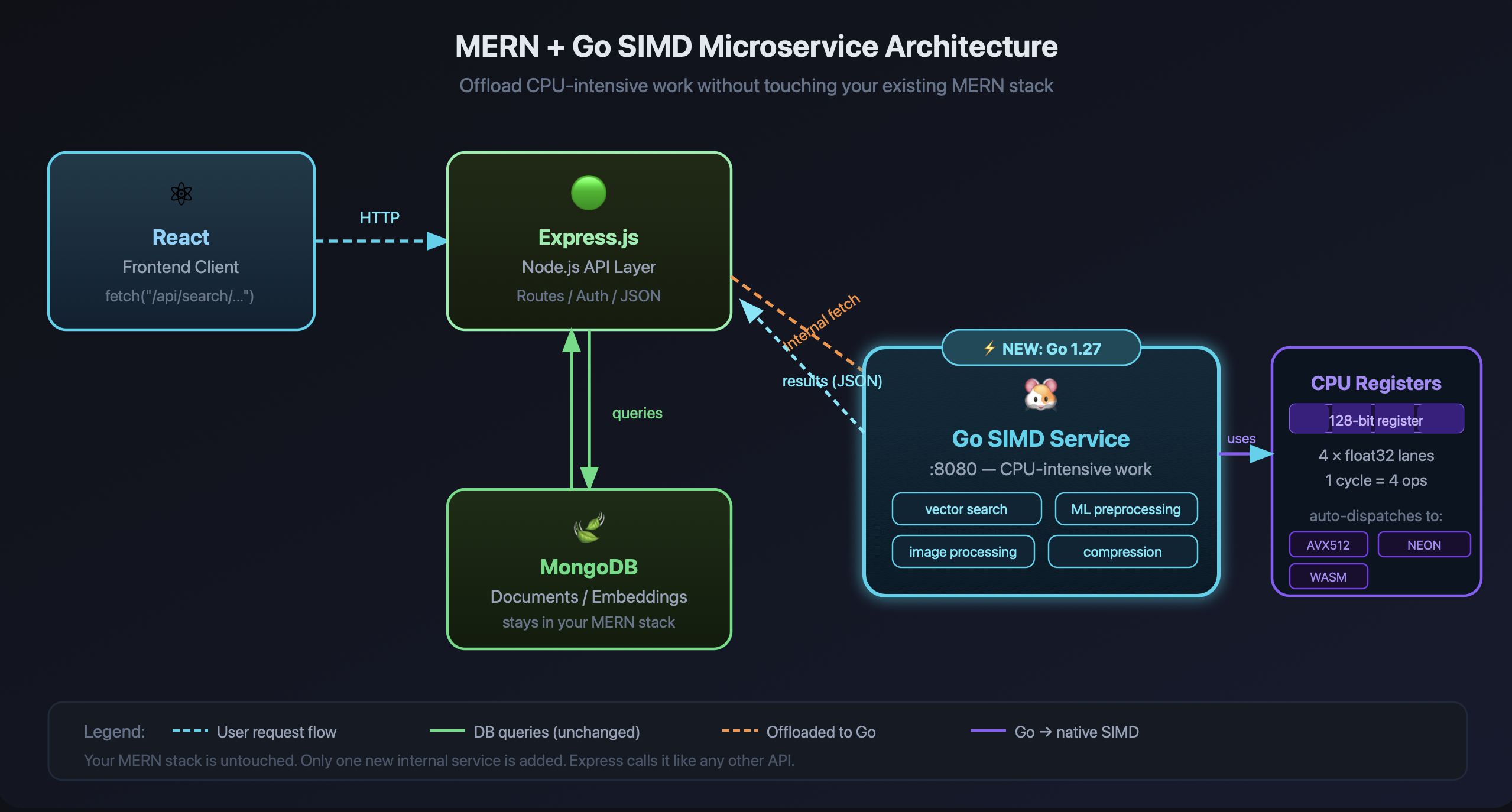
The architectural move here isn't complicated. You keep your MERN stack doing what it's good at — API routing, auth, MongoDB queries, React rendering. You carve out the CPU-intensive operation into a small Go service. Express calls it like any other internal API.
// Express route — stays in your MERN stack
app.post('/api/search/similar', async (req, res) => {
  const { queryEmbedding } = req.body;

  // Offload the vector similarity math to Go
  const response = await fetch('http://go-simd-service:8080/similarity', {
    method: 'POST',
    headers: { 'Content-Type': 'application/json' },
    body: JSON.stringify({ query: queryEmbedding, topK: 10 }),
  });

  const { results } = await response.json();

  // Enrich from MongoDB as usual
  const docs = await Document.find({ _id: { $in: results.map(r => r.id) } });
  res.json(docs);
});
On the Go side, you get a tiny HTTP service that does nothing but crunch numbers fast:
// go-simd-service/main.go
package main

import (
    "encoding/json"
    "net/http"
    "golang.org/x/exp/simd"
)

type SimilarityRequest struct {
    Query []float32 `json:"query"`
    TopK  int       `json:"topK"`
}

func cosineSimilarity(a, b []float32) float32 {
    // innerProduct using simd.Float32s (same as above)
    dot := innerProduct(a, b)
    normA := innerProduct(a, a)
    normB := innerProduct(b, b)
    return dot / (sqrt(normA) * sqrt(normB))
}

func similarityHandler(w http.ResponseWriter, r *http.Request) {
    var req SimilarityRequest
    json.NewDecoder(r.Body).Decode(&req)

    // ... compare against your vector store, return top K
    // Go handles the heavy float32 math with SIMD under the hood
}

func main() {
    http.HandleFunc("/similarity", similarityHandler)
    http.ListenAndServe(":8080", nil)
}
Your React frontend never knows the difference. Your MongoDB queries stay in Express where they belong. The only change is one internal HTTP call that now runs in microseconds instead of hundreds of milliseconds.
Practical Takeaways
Don't reach for this everywhere. If your bottleneck is I/O (database calls, external APIs, file reads), Go + SIMD won't help. Node.js is already excellent at I/O-bound work. Profiling before migrating is non-negotiable.
Benchmark across vector widths. A key quirk of the new simd package: wider isn't always faster. Use GODEBUG=simd=0,128,256,512 to test your specific workload and dataset sizes. Sometimes 128-bit vectors outperform 512-bit ones on small arrays due to setup overhead.
Start with one route. You don't need to migrate your whole backend. Identify the one Express route that's hurting you, extract it into a Go service, and measure. Keep everything else exactly as it is.
Go 1.28 is adding more. Horizontal reductions (ReduceSum), SVE support for arm64, and shuffle operations are all coming. If you're building something now, design your API so the Go layer is easy to update when 1.28 lands.
The Bottom Line
Go 1.27 lowered the bar for writing performant, hardware-accelerated code. You don't need to know the difference between AVX512 and NEON to take advantage of your server's SIMD units anymore. You write simd.Float32s, and Go figures out the rest.
For MERN developers, the use case is real and growing — vector search and ML preprocessing are no longer niche features. If you've been putting off that "add semantic search to the app" ticket because you couldn't justify the Node.js performance cost, this is your opening.
Try it. Write the Go service, call it from Express, and let your event loop breathe.
What's the slowest route in your MERN app? Drop it in the comments — curious what people are actually hitting walls with.