Node.js 26 Is Now LTS: What Every MERN Developer Actually Needs to Know
October is here, and that means Node.js 26 just crossed the line from "interesting to watch" into "you need a plan for this." It officially enters Long-Term Support this month, which means it's the version your team should be evaluating for production — and the biggest headliner is something JavaScript developers have been begging for since roughly forever: the Temporal API, finally enabled by default.
Let's dig in.
Why LTS Timing Matters for Your Team
Node.js follows an even-numbered LTS cycle: versions 24, 26, 28 get the long-term treatment. Odd-numbered versions (25, 27) are short-lived Current releases. Node.js 26 was released back in April 2026 as a Current build — great for experimentation, risky for production. Now that it's LTS, you get 30 months of Active LTS support and another 18 months of maintenance after that.
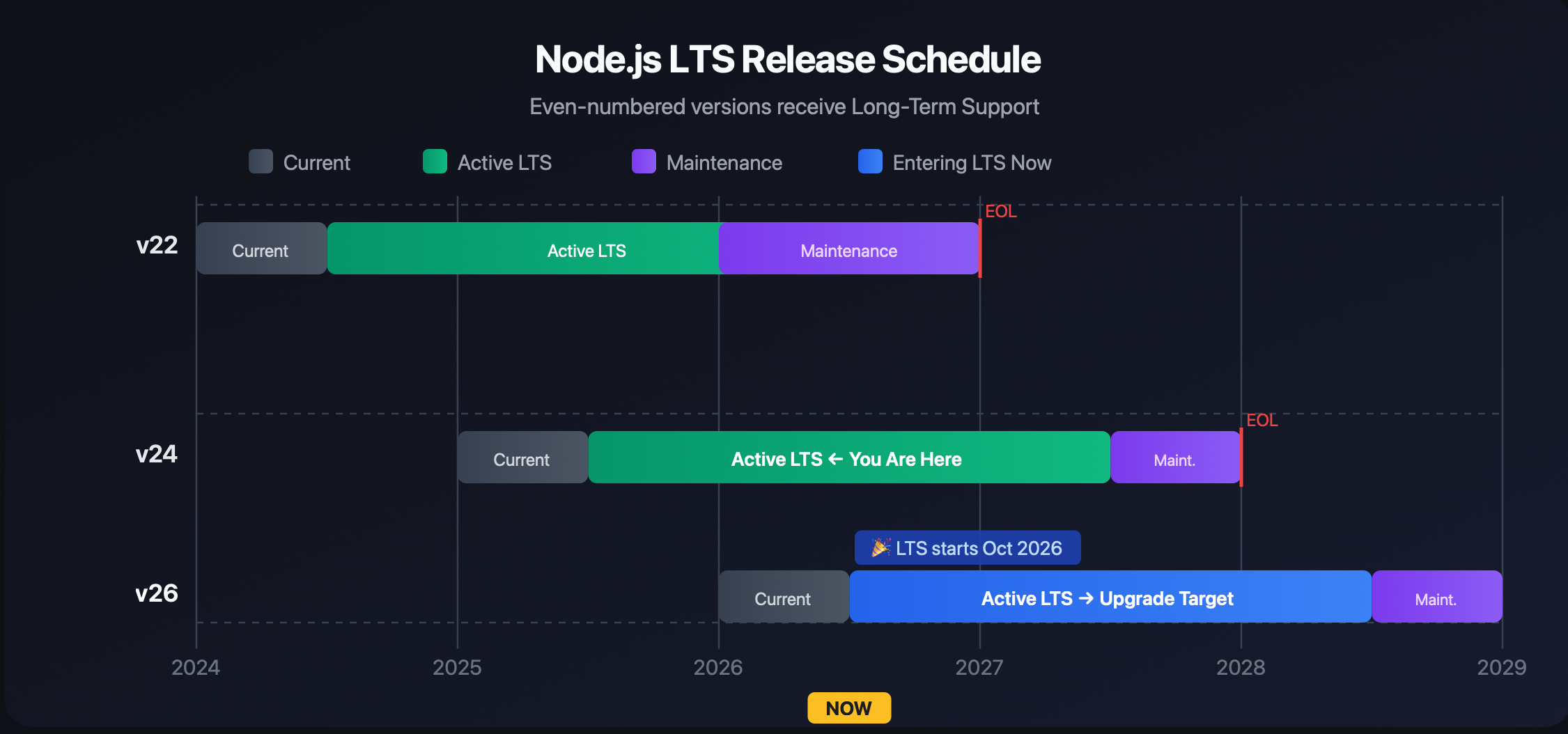
Node.js 24 is still in Active LTS and perfectly fine for production. But 26 is where the language is heading, and the sooner your team starts testing against it, the fewer nasty surprises you'll have when 24's window closes. For greenfield MERN projects, 26 is worth starting with today.
The Temporal API: JavaScript Dates, Finally Fixed
If you've ever cried a little inside while writing new Date(someTimestamp - (offset * 60 * 1000)) or wrestled with daylight saving time bugs in your Express API, this one's for you.
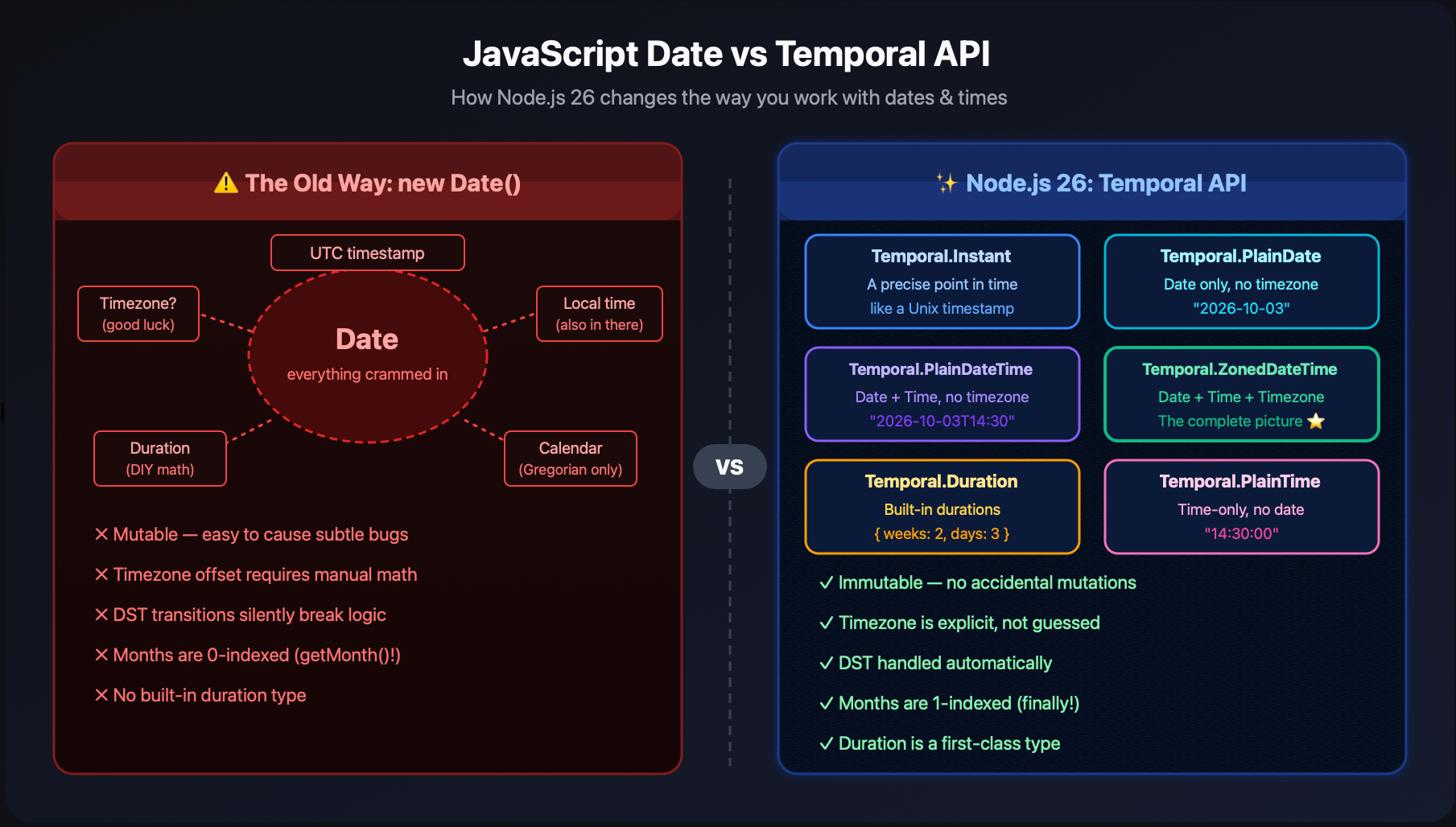
The Temporal API separates what the Date object tried to smash into one confused blob: dates, times, timezones, and durations are now separate, explicit types. And in Node.js 26, it's on by default — no experimental flags, no --harmony-temporal noise.
// The old way — a prayer disguised as code
const now = new Date();
const nextWeek = new Date(now.getTime() + 7 * 24 * 60 * 60 * 1000);

// Timezone handling? You mostly just hope for the best.
// new Date() gives you UTC and local — that's basically it
// Temporal API — Node.js 26, no flags needed
const now = Temporal.Now.plainDateTimeISO();
const nextWeek = now.add({ weeks: 1 });

// Timezone-aware datetime — explicit and readable
const nyTime = Temporal.Now.zonedDateTimeISO('America/New_York');
const lagosTime = nyTime.withTimeZone('Africa/Lagos');
console.log(`New York: ${nyTime.toLocaleString()}`);
console.log(`Lagos:    ${lagosTime.toLocaleString()}`);

// Duration math that doesn't require mental gymnastics
const start = Temporal.PlainDate.from('2026-01-01');
const end   = Temporal.PlainDate.from('2026-10-03');
const diff  = start.until(end);
console.log(`Days elapsed: ${diff.days}`); // 275 — clean and correct
The key types to keep in your head:
Temporal.Instant— a precise point in time (think: a timestamp)Temporal.PlainDate— a date with no time zone (2026-10-03, always)Temporal.PlainDateTime— date + time, still no zoneTemporal.ZonedDateTime— the full picture: date, time, and timezone baked in
That explicit separation eliminates an entire class of timezone bugs from your backend. If your MERN app handles bookings, scheduling, events, or anything cross-timezone, this alone justifies the upgrade.
V8 14.6: Two Small APIs Worth Knowing
Node.js 26 ships with V8 14.6, and two additions are genuinely useful day-to-day.
Map.prototype.getOrInsert() is a clean upsert operation that removes the "check-then-set" boilerplate most of us write by hand:
const requestCounts = new Map();

// Before — a little verbose, a lot common
function trackRequest(userId) {
  if (!requestCounts.has(userId)) {
    requestCounts.set(userId, 0);
  }
  requestCounts.set(userId, requestCounts.get(userId) + 1);
}

// After — getOrInsert returns the existing value or inserts the default
function trackRequest(userId) {
  const count = requestCounts.getOrInsert(userId, 0);
  requestCounts.set(userId, count + 1);
}
Iterator.concat() chains iterables without spreading them into arrays, which matters when you're working with large MongoDB cursor results or Node.js streams:
const activeUsers  = db.collection('users').find({ active: true });
const pendingUsers = db.collection('users').find({ status: 'pending' });

// Combine iterables without materializing both into memory first
for await (const user of Iterator.concat(activeUsers, pendingUsers)) {
  await processUser(user);
}
Small wins, but they add up across a large MERN codebase.
Breaking Changes That Could Bite Your App
This is the part that actually matters before you flip the switch. A few things were removed in Node.js 26:
http.Server.prototype.writeHeader() is gone. If you have old Express middleware or custom HTTP handlers using it, the fix is simple:
// ❌ Removed in Node.js 26
res.writeHeader(200, { 'Content-Type': 'application/json' });

// ✅ Use this — it's been the correct method for years anyway
res.writeHead(200, { 'Content-Type': 'application/json' });
Legacy private stream modules are gone. If any of your dependencies import from _stream_readable, _stream_writable, or the other underscore-prefixed stream modules, they'll throw on Node.js 26. The fix is to use require('stream') directly — which is what they should have been doing all along.
// ❌ These modules no longer exist
const { Readable } = require('_stream_readable');

// ✅ Use the public API
const { Readable } = require('stream');
Native add-ons need a rebuild. If your project uses native Node.js modules — things like node-canvas, certain database drivers, or native crypto packages — you'll need to rebuild them because NODE_MODULE_VERSION bumped to 147.
The honest approach: spin up a Node.js 26 container locally, run your full test suite against it, and see what breaks. Most modern MERN stacks with up-to-date dependencies will be clean.
Temporal in Your React Frontend: The Polyfill Situation
Here's the catch the Node.js 26 release notes don't shout about: browser support sits around 69% globally as of October 2026. Chrome, Edge, and Firefox have it. Safari does not — not even in Technology Preview.
That means if you're building a React app that serves iOS or macOS Safari users (and you almost certainly are), you can't rely on native Temporal in the browser yet. The workaround is the official polyfill:
npm install @js-temporal/polyfill
// In your React entry point (main.jsx / index.tsx)
import { Temporal } from '@js-temporal/polyfill';

// Use it exactly like the native API — same methods, same types
function DaysUntilDeadline({ deadline }) {
  const today  = Temporal.Now.plainDateISO();
  const target = Temporal.PlainDate.from(deadline);
  const { days } = today.until(target);

  return <p>{days} day{days !== 1 ? 's' : ''} remaining</p>;
}
The polyfill adds roughly 20–56 KB to your bundle depending on tree-shaking. Not tiny, but manageable. A solid strategy: use native Temporal in your Node.js 26 backend unconditionally (it's there, it's fast, use it), and keep the polyfill scoped to your React frontend until Safari catches up.
Should You Upgrade Your MERN Stack Right Now?
Here's the honest breakdown depending on where you are:
Greenfield project? Start on Node.js 26 LTS. You get Temporal out of the box, V8 14.6 features, and you won't have to migrate later. No reason not to.
Existing project on Node.js 24? You're fine — 24 is in Active LTS and secure. Start evaluating 26 in your next sprint: run your test suite against it, fix the handful of breaking changes, and plan a migration. There's no panic here.
Project still on Node.js 22 or older? That's the one to prioritize. Node.js 22 is approaching end of life, and you're leaving security patches on the table. Upgrade paths: 22 → 24 first to get stable, then 24 → 26 when you're ready.
The Temporal API alone is worth the upgrade when the time comes. If you've ever lost an hour to a timezone bug in a booking system or an event scheduler — or shipped a date bug that hit users in a different timezone — you know exactly what I mean.
Wrapping Up
Node.js 26 going LTS isn't a flashy launch event — it's the moment a well-baked version becomes something you can actually bet production on. The Temporal API is the standout feature that'll change how you write date logic for good, the V8 14.6 additions are handy quality-of-life improvements, and the breaking changes are real but manageable with a test suite.
If you haven't already, spin up a Node.js 26 container in your dev environment today, point your test suite at it, and see where things stand. You'll probably be pleasantly surprised at how little actually breaks.
Got questions about migrating your specific MERN setup? Drop them in the comments — happy to dig in.