OpenAI DevDay 2026: What MERN Developers Actually Need to Know

OpenAI held DevDay 2026 on September 29th and dropped 20+ announcements back to back. If you spent the day actually shipping code (respect), here's the honest breakdown of what matters for folks building with the MERN stack — no hype, just the stuff you'll actually reach for.
GPT-6.1 Sol: Your New Default Model for AI Features
This one's worth leading with because it directly hits your wallet.
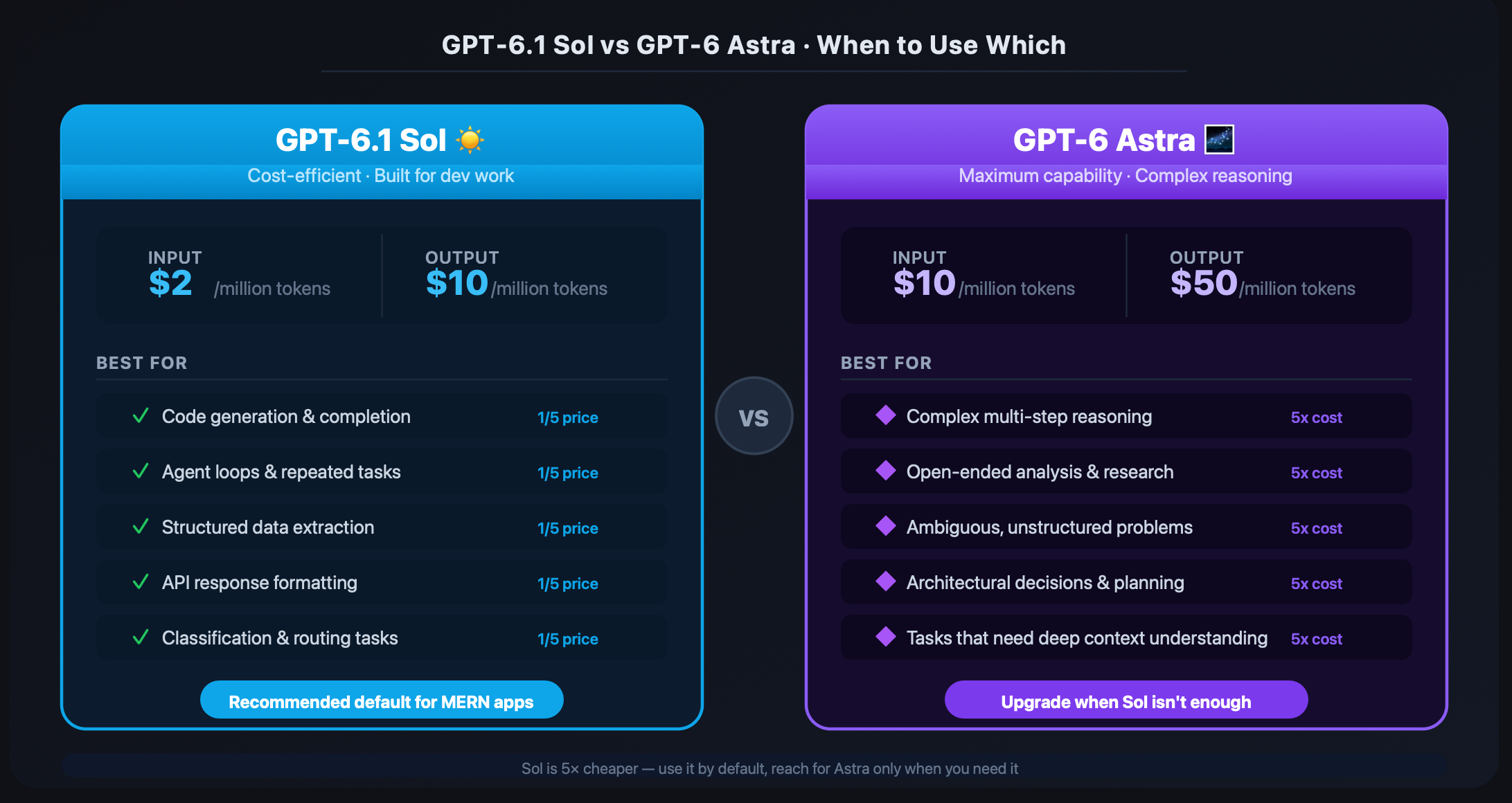
GPT-6.1 Sol is priced at $2 per million input tokens and $10 per million output tokens — about one-fifth the cost of GPT-6 Astra. And the kicker? OpenAI says it matches Astra's performance on coding and repeated agent tasks. That's the category most of us are building in.
If you've been holding off on adding AI-powered features to your Express API because costs spiral unpredictably, Sol changes that calculus. A rough mental model: use Sol by default for everything that involves code generation, structured data extraction, or task automation. Only reach for Astra when you actually need complex multi-step reasoning on unstructured, open-ended problems.
Here's how you'd set that up cleanly in a Node.js service:
// services/aiRouter.js
import OpenAI from "openai";

const client = new OpenAI({ apiKey: process.env.OPENAI_API_KEY });

const MODELS = {
  default: "gpt-6.1-sol",     // coding, extraction, agent loops
  heavy:   "gpt-6-astra",     // complex reasoning, open-ended analysis
};

export async function callAI(prompt, { heavy = false } = {}) {
  const model = heavy ? MODELS.heavy : MODELS.default;

  const response = await client.chat.completions.create({
    model,
    messages: [{ role: "user", content: prompt }],
  });

  return response.choices[0].message.content;
}
Small habit shift, real savings at scale. Most MERN apps don't need Astra 90% of the time.
The Decisions API: AI Classification Right in Your Middleware
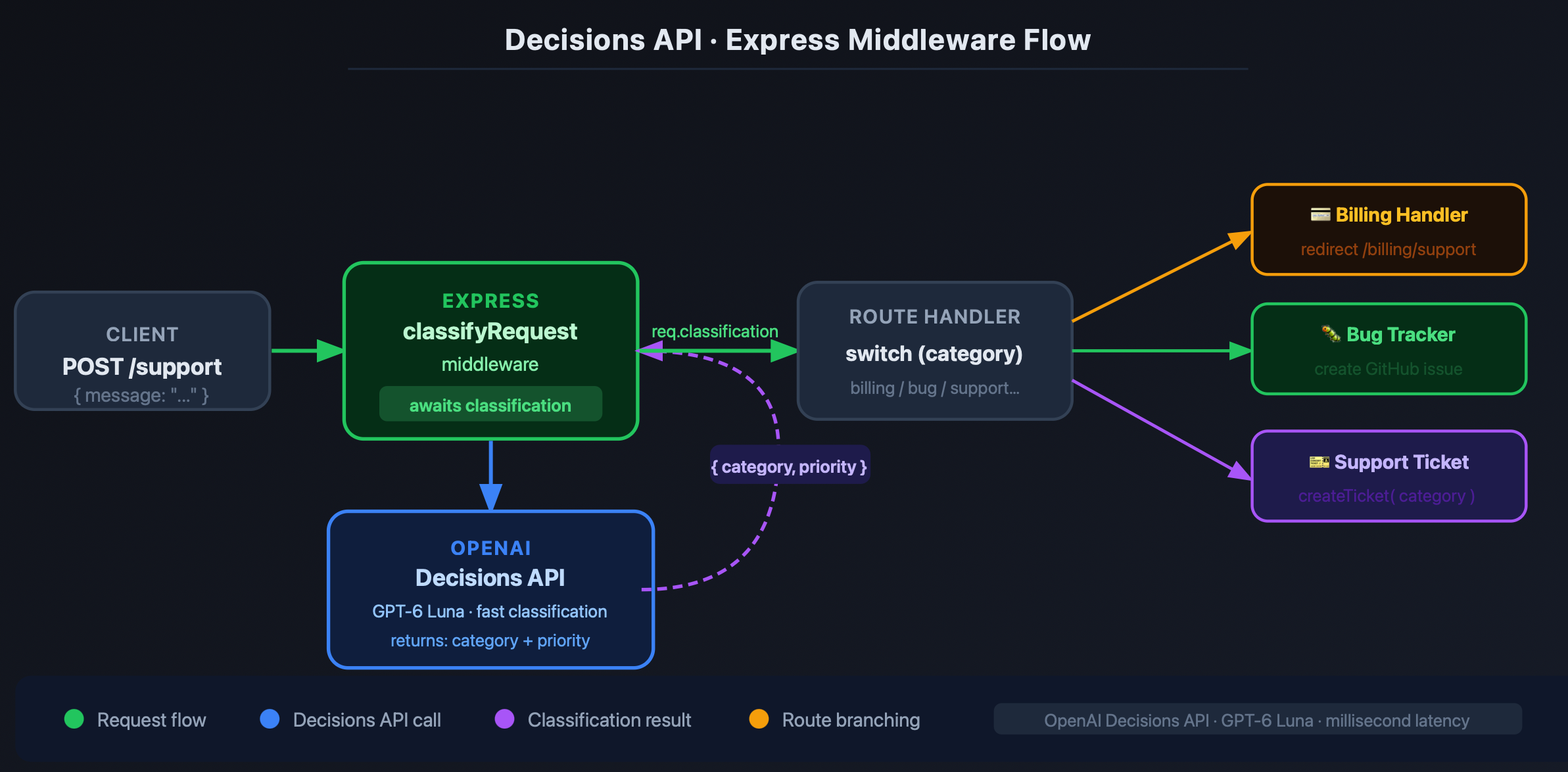
This is the quiet announcement that I think will age the best. The Decisions API lets you send context (text or images) and ask a finite set of questions, getting back structured answers — fast. Think milliseconds, not seconds. It runs on GPT-6 Luna under the hood, which is optimized for speed over deep reasoning.
The use case fits almost too perfectly into Express middleware patterns. Imagine you're building an app with user-submitted content — you need to classify it (is this spam? is it a support request or a bug report? does this image violate guidelines?) before routing it anywhere. Previously you'd either write a regex mess or use a full LLM call and eat the latency.
With the Decisions API, that becomes a fast classification step you can drop into your middleware chain:
// middleware/classifyRequest.js
import OpenAI from "openai";

const client = new OpenAI({ apiKey: process.env.OPENAI_API_KEY });

export async function classifyRequest(req, res, next) {
  const { message } = req.body;

  if (!message) return next();

  // Decisions API call — structured, fast classification
  const decision = await client.decisions.create({
    context: message,
    questions: [
      {
        id: "category",
        question: "What category does this message fall into?",
        options: ["bug_report", "feature_request", "billing", "general_support"],
      },
      {
        id: "priority",
        question: "What is the urgency level of this message?",
        options: ["low", "medium", "high"],
      },
    ],
  });

  // Attach classification to request object
  req.classification = {
    category: decision.answers.category,
    priority: decision.answers.priority,
  };

  next();
}

// In your router
import { classifyRequest } from "../middleware/classifyRequest.js";

router.post("/support", classifyRequest, async (req, res) => {
  const { category, priority } = req.classification;

  // Route to the right handler based on AI classification
  if (category === "billing") {
    return res.redirect("/billing/support");
  }

  await createTicket({ ...req.body, category, priority });
  res.json({ status: "created", category, priority });
});
This is genuinely cleaner than the hacky LLM prompts most of us have been writing for classification. And since it's a limited preview right now, worth getting on the waitlist early.
Dots and the Agents API: "Always-On" Isn't Just a Buzzword
OpenAI also shipped Dots — persistent agents that run continuously in the cloud, monitor things, and take action without you needing to poke them. They connect to 4,000+ apps, remember your preferences, and pick up tasks proactively. For end users, it's a new kind of AI assistant. For us as developers, it signals where the Agents API is going.
The Agents API (now in public beta and with new capabilities) is the developer-facing version of this. What's new since the initial beta:
Parallel subagents — you can spawn agents that run concurrently and aggregate their results
Persistent session state — context survives across interactions, no more manually stitching conversation history
Built-in browser use — agents can navigate the web as part of their workflow
MCP server connections — your agents can plug into Model Context Protocol servers for custom tools
For a MERN backend, think about a scenario where you want an agent to monitor your MongoDB collection for anomalies and send a Slack alert. Previously that's a cron job with a bunch of LLM glue code. With the Agents API, you can define the tools (query DB, send Slack) and let the agent handle the when and how — persistently, without a running process on your end.
// Example: defining a monitoring agent with tool access
const agent = await client.agents.create({
  model: "gpt-6.1-sol",
  instructions: "Monitor the orders collection for anomalies. Alert via Slack if error rate exceeds 5% in any 10-minute window.",
  tools: [
    { type: "function", function: queryOrdersSchema },
    { type: "function", function: sendSlackAlertSchema },
  ],
  session: { persistent: true },
});
It's still maturing, but the direction is clear: AI that runs alongside your backend rather than inside it.
Sign in with ChatGPT: A New Auth Pattern Worth Tracking
OpenAI launched Sign in with ChatGPT — similar to Sign in with Google, but it lets users bring their existing ChatGPT plan (and its usage limits) into partner apps. Vercel, Notion, and Cognition's Devin are among the 16 launch partners.
For most MERN apps, this isn't actionable today. But if your app has any overlap with the developer productivity, writing, or automation spaces, this is worth watching. The interesting angle: users don't need to create a new account or enter a new API key — they just bring their subscription. Lower friction, and OpenAI handles the billing complexity. Keep an eye on the docs as this rolls out more broadly.
The Honest MERN Dev Playbook for This Week
None of this requires a full rewrite of your stack. Here's where I'd actually spend time:
Swap your default model to Sol for anything code or task-related — do this today, your costs will drop
Apply for Decisions API preview access — plug it into your first classification middleware as a proof of concept
Read the new Agents API docs — especially the persistent session and parallel subagent features; they solve real pain points
Don't panic about Dots — it's a consumer feature for now; the developer story is the Agents API
OpenAI dropped a lot at DevDay, and most of it is noise for day-to-day development. But Sol's pricing, the Decisions API, and the Agents API updates are three concrete things you can actually use. Pick the one that fits your current project and spend 30 minutes prototyping — that's usually where it clicks.
What are you building with these? If you're already using the Agents API in your MERN app, I'd genuinely love to hear about it in the comments.