Python Finally Killed the GIL: What Free-Threading in 3.14 Means for Your Stack

For thirty years, one line in Python's source code quietly haunted every developer who tried to squeeze real concurrency out of the language. The Global Interpreter Lock — the GIL — meant that no matter how many CPU cores your server had, only one Python thread ran at a time. You could spawn a hundred threads, but they'd all be waiting their turn at the door.
Python 3.14 just made that lock optional. And if you're a MERN developer who's ever side-eyed Python for backend microservices or ML preprocessing work, this is the moment to pay attention.
What Was the GIL, Actually?
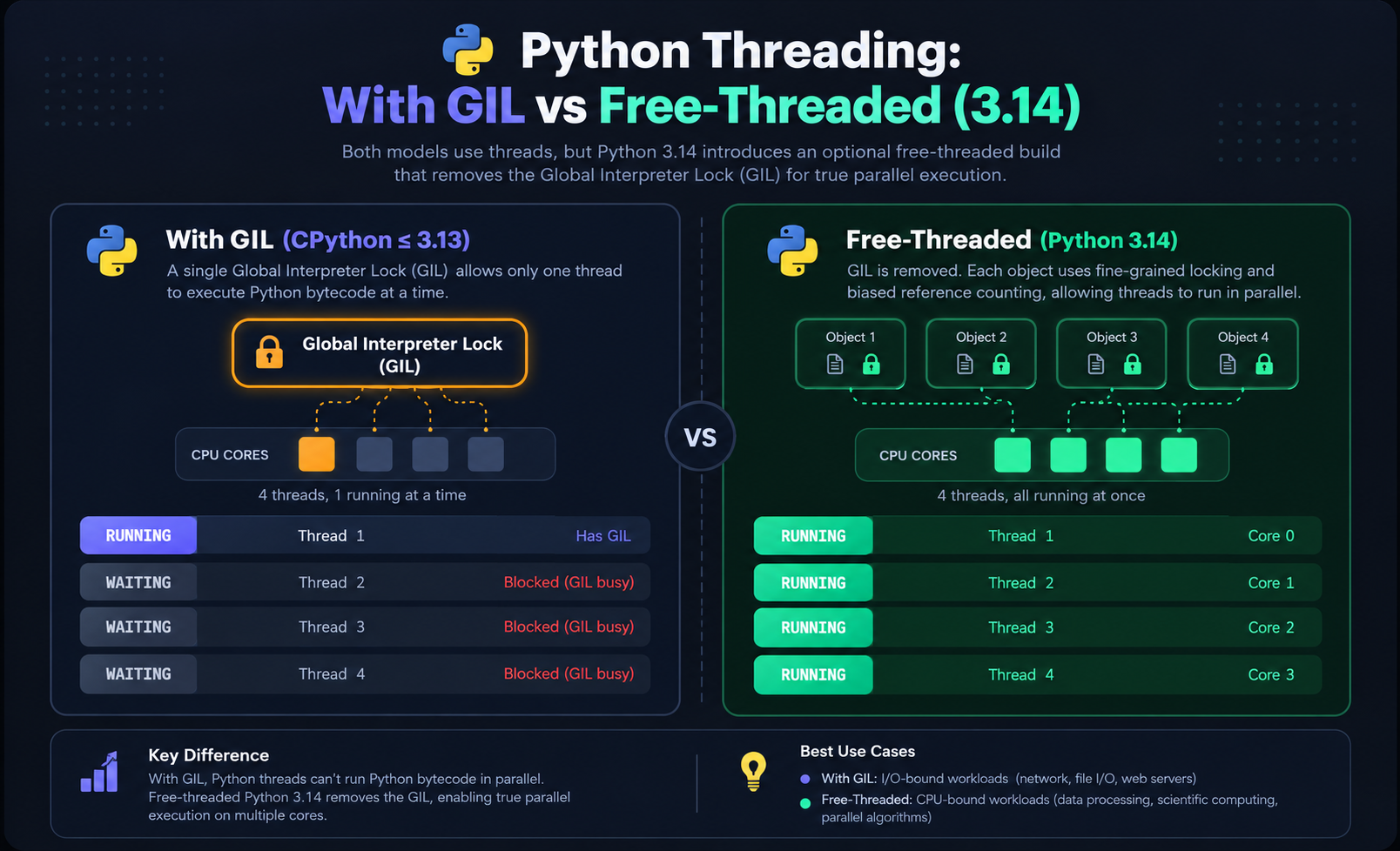
The GIL is a mutex — a mutual exclusion lock — that the CPython interpreter used to protect its internal memory management. Python's reference counting garbage collector isn't thread-safe by default, so rather than building fine-grained locking into every object, the original developers took a simpler route: one big lock for the whole interpreter. One thread runs, the others wait.
This was pragmatic in 1991. On single-core machines, it barely mattered. For I/O-bound workloads (which is most web work), it barely matters today — threads release the GIL while waiting on network or disk, so async frameworks like FastAPI and Django work fine. The GIL only shows its teeth when you throw CPU-heavy work at Python threads: parsing, hashing, image transforms, matrix ops, data pipeline processing.
Node.js developers will find this familiar. Node's event loop is single-threaded too. The difference is that Node leans into it — non-blocking I/O is the whole model. Python tried to paper over it with threads, and the GIL made that awkward.
Python 3.14: Per-Object Locking Replaces the Single Lock
PEP 779, stabilized in Python 3.14, brings free-threaded builds out of experimental status (they were opt-in experimental in 3.13). The implementation is genuinely clever: instead of one global lock, CPython now uses per-object locking combined with biased reference counting.
Biased reference counting works like this: each object "belongs" to the thread that created it. For that thread, reference count updates happen without any locking at all — fast, cheap, local. Only when another thread touches an object do you pay the synchronization cost. In practice, most objects in most programs are thread-local most of the time, so the overhead stays low.
To run free-threaded Python 3.14:
# Build from source with GIL disabled
./configure --disable-gil --enable-experimental-jit
make -j4

# Or install with uv (the new standard Python package manager)
uv python install 3.14t  # 't' suffix = free-threaded build
uv run --python 3.14t myscript.py
Once you're on a free-threaded build, real parallel threads work the way you'd expect:
import threading
import time

def crunch_numbers(n):
    """CPU-bound: this will now actually parallelize."""
    result = 0
    for i in range(n):
        result += i * i
    return result

# On GIL Python: ~4 seconds (threads waiting on each other)
# On free-threaded Python: ~1 second on a 4-core machine
threads = [threading.Thread(target=crunch_numbers, args=(10_000_000,)) for _ in range(4)]

start = time.time()
for t in threads:
    t.start()
for t in threads:
    t.join()

print(f"Done in {time.time() - start:.2f}s")
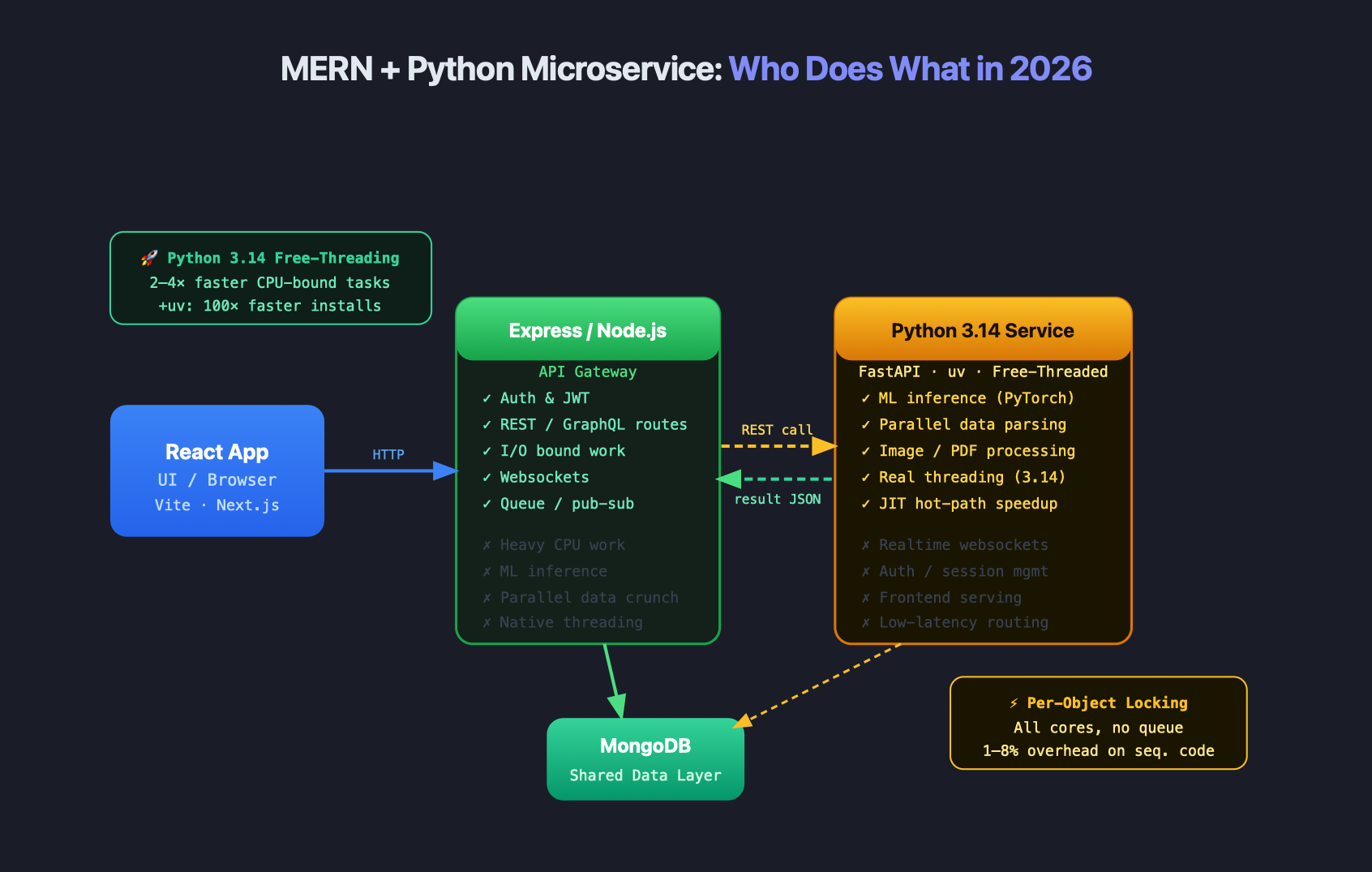
Early benchmarks show 2–4x speedups on multi-threaded CPU-bound tasks running on 4-core machines. Sequential, single-threaded code sees a modest 1–8% slowdown from the added per-object locking infrastructure — a reasonable trade.
The JIT Compiler: The Other Half of the Story
Free-threading is the headline, but Python 3.14 ships another major performance lever: an experimental JIT (Just-In-Time) compiler, enabled alongside free-threading.
The JIT watches your running code and identifies "hot" paths — loops and functions that execute repeatedly. It then compiles those paths to native machine code at runtime, bypassing the interpreter's normal bytecode execution.
# This kind of tight loop is exactly what JIT targets
def dot_product(a: list[float], b: list[float]) -> float:
    total = 0.0
    for x, y in zip(a, b):
        total += x * y   # JIT will compile this to native math ops
    return total

# After a few calls, the JIT kicks in and this gets fast
a = [float(i) for i in range(100_000)]
b = [float(i) for i in range(100_000)]

for _ in range(1000):
    dot_product(a, b)   # Subsequent calls hit the compiled path
The JIT is still experimental — you won't turn it on in production tomorrow. But combine "real parallelism" from free-threading with "faster per-core execution" from the JIT, and you're looking at Python finally becoming a credible option for workloads that previously screamed for Go or Rust.
What This Changes for Your MERN Backend
Let's be direct about the practical implications, because there are real nuances here.
If you're running FastAPI or Django with multiple worker processes (which most production setups do), free-threading doesn't move the needle much. Each worker is already a separate process with its own Python interpreter. You're already getting parallelism at the process level.
Where free-threading genuinely matters is within a single process that needs to parallelize CPU work:
from concurrent.futures import ThreadPoolExecutor
import json

# Before free-threading: these threads would queue up on the GIL
# After free-threading: they run genuinely in parallel
def parse_and_transform(raw_json: str) -> dict:
    data = json.loads(raw_json)           # CPU work
    data["processed"] = True
    data["score"] = sum(v for v in data.get("values", []))  # CPU work
    return data

payloads = [generate_big_json() for _ in range(100)]

with ThreadPoolExecutor(max_workers=8) as pool:
    results = list(pool.map(parse_and_transform, payloads))
For MERN developers, the most compelling use case is Python microservices for ML preprocessing or heavy data work sitting alongside your Node.js API layer. That pattern was already popular (Node handles routing and I/O, Python handles the compute). Free-threading makes the Python side genuinely more efficient when you need parallelism without the overhead of spawning processes.
Also worth knowing: uv is now the de-facto Python package manager. If you've avoided Python because pip, venv, pyenv, and poetry felt like four tools doing one job badly, uv consolidates all of it and runs 10–100x faster than the old toolchain:
# Install uv
curl -LsSf https://astral.sh/uv/install.sh | sh

# Start a new Python project — this replaces pip + venv + pyenv
uv init my-data-service
cd my-data-service

uv add fastapi httpx numpy   # Installs in seconds, not minutes
uv run fastapi dev main.py
One caveat: C extension compatibility. Some popular packages (numpy, certain ML libs) need to ship free-threaded wheels for the performance gains to flow through. The ecosystem is catching up fast, but check your dependency chain before switching a production service to a 3.14t build.
Should You Actually Care?
Here's the honest take: if your Python work is mostly Django REST endpoints and async FastAPI routes, the GIL was never your bottleneck. Free-threading doesn't change your day-to-day.
But if you've ever had to explain to your team why a Python data pipeline is slower than it should be on a 16-core machine, or why you need to spin up 16 processes just to use 16 cores — that conversation just changed. Python 3.14 with free-threading is the first version where threading is a genuinely valid tool for CPU-bound parallelism, not a trap that teaches you why you should have used multiprocessing instead.
For the MERN developer who wants Python in the toolkit: now is a good time to look again. The language has been quietly fixing its biggest architectural wart for three years. In 3.14, that fix is stable. Combined with uv's sane package management, writing a lightweight Python microservice alongside your Express API is a much smoother experience than it was even 18 months ago.
The GIL isn't quite dead yet — it's still the default in regular CPython builds — but for the first time in 30 years, it's a choice, not a sentence.
Are you already running Python services alongside your Node stack? Drop a comment — I'm curious what workloads are driving the Python side for folks in mostly-JS shops.