SpaceX Just Bought Your Code Editor — What MERN Devs Need to Know
You probably didn't notice the day it happened. You opened Cursor like any other morning, asked it to refactor a React hook, and shipped your feature. But on June 16, 2026, SpaceX announced it was buying Anysphere — the company behind Cursor — for $60 billion in an all-stock deal. The largest acquisition of a venture-backed startup in history. And if Cursor is part of your daily MERN stack workflow, the ripples from this are worth paying attention to.
Let me break down what actually happened, what it means right now, and — more importantly — what you should probably be doing about it.
The Deal: SpaceX + xAI + Cursor
Here's the context that makes this more than just a headline.
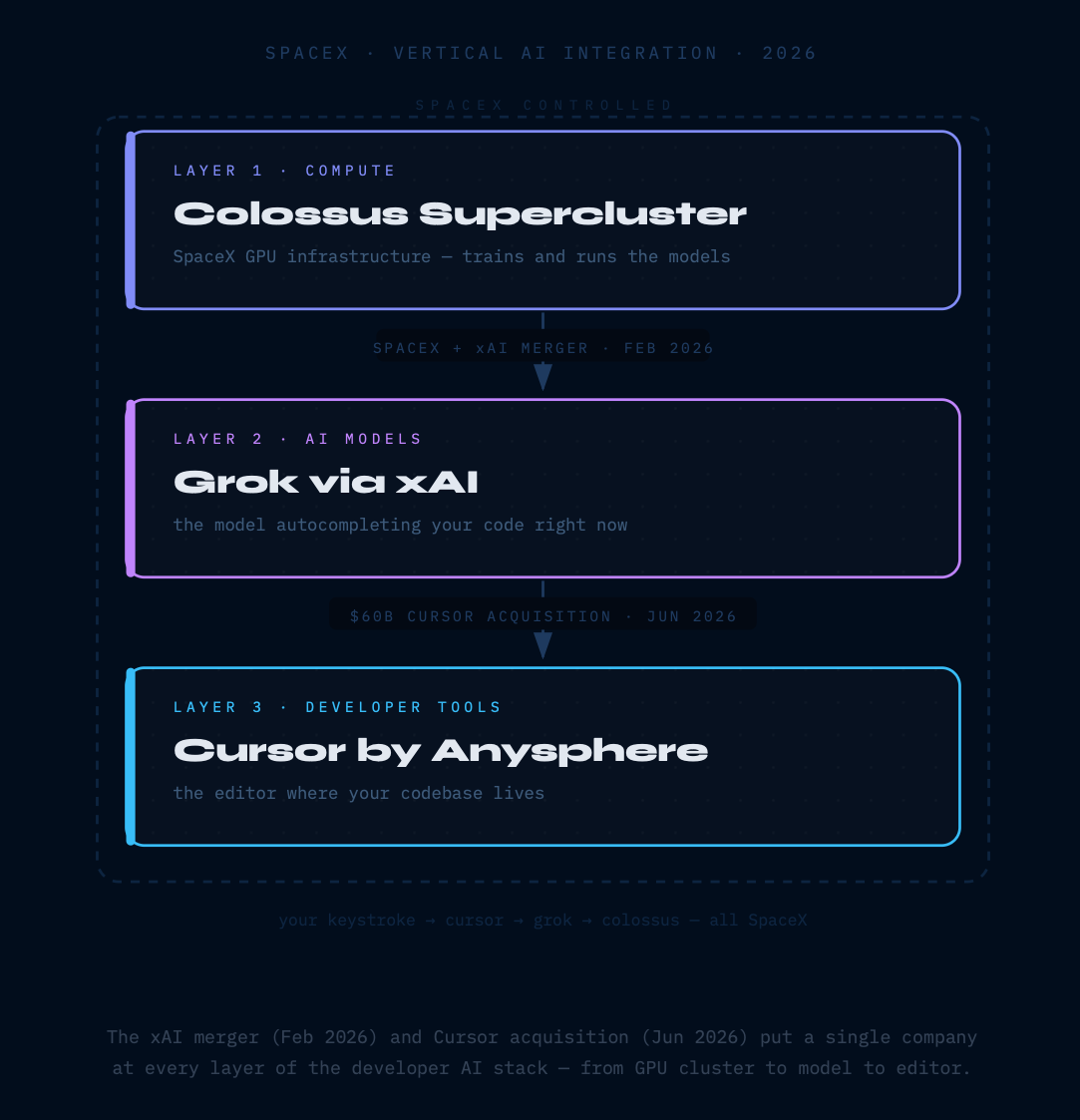
Back in February 2026, SpaceX merged with xAI — Elon Musk's AI company behind the Grok models. That combined entity then acquired Cursor, giving SpaceX a vertically integrated AI stack that most tech companies would kill for:
Compute: The Colossus supercluster (one of the largest GPU clusters in the world)
Models: Grok (via xAI)
Developer tooling: Cursor (with ~$4 billion in annualized revenue and $2.6 billion in enterprise contracts)
Think of it like if AWS had also built the IDE you code in, and the foundational model powering your autocomplete. That's the level of vertical integration we're talking about.
For now, Cursor works exactly as it always has. Claude, GPT-4o, Gemini — all still accessible. Pricing hasn't changed. Your .cursor/rules files still work. Nothing broke.
But there's a longer game being played here, and that's where it gets interesting.
The Slow Squeeze: What Developers Are Actually Worried About
The concern isn't what SpaceX will do tomorrow. It's what they can do over the next 12–24 months.
SpaceX now has a financial incentive to gradually shift Cursor users toward Grok. They're already building a jointly trained SpaceXAI-Cursor model. Initially it'll ship as "an option." Then probably the default. Then third-party model access might quietly get a little worse, or a little more expensive, or just a little slower.
Nobody's accusing them of bad faith. But they're a business, and their business now includes model hosting costs. The structural incentive is there, and that's enough to make a lot of developers uncomfortable.
For MERN devs specifically, this hits close to home because so many of us use Cursor to:
Navigate large Express codebases
Write boilerplate MongoDB aggregation pipelines
Generate React component scaffolding
Debug async Node.js logic
If model quality or model choice degrades over time, that's a workflow hit. And enterprise teams especially are starting to ask: did we just hand a SpaceX subsidiary access to our proprietary codebase?
OpenCode: The Open-Source Answer
While all of this was brewing, a project called OpenCode quietly crossed 160,000 GitHub stars — and it's worth knowing about.
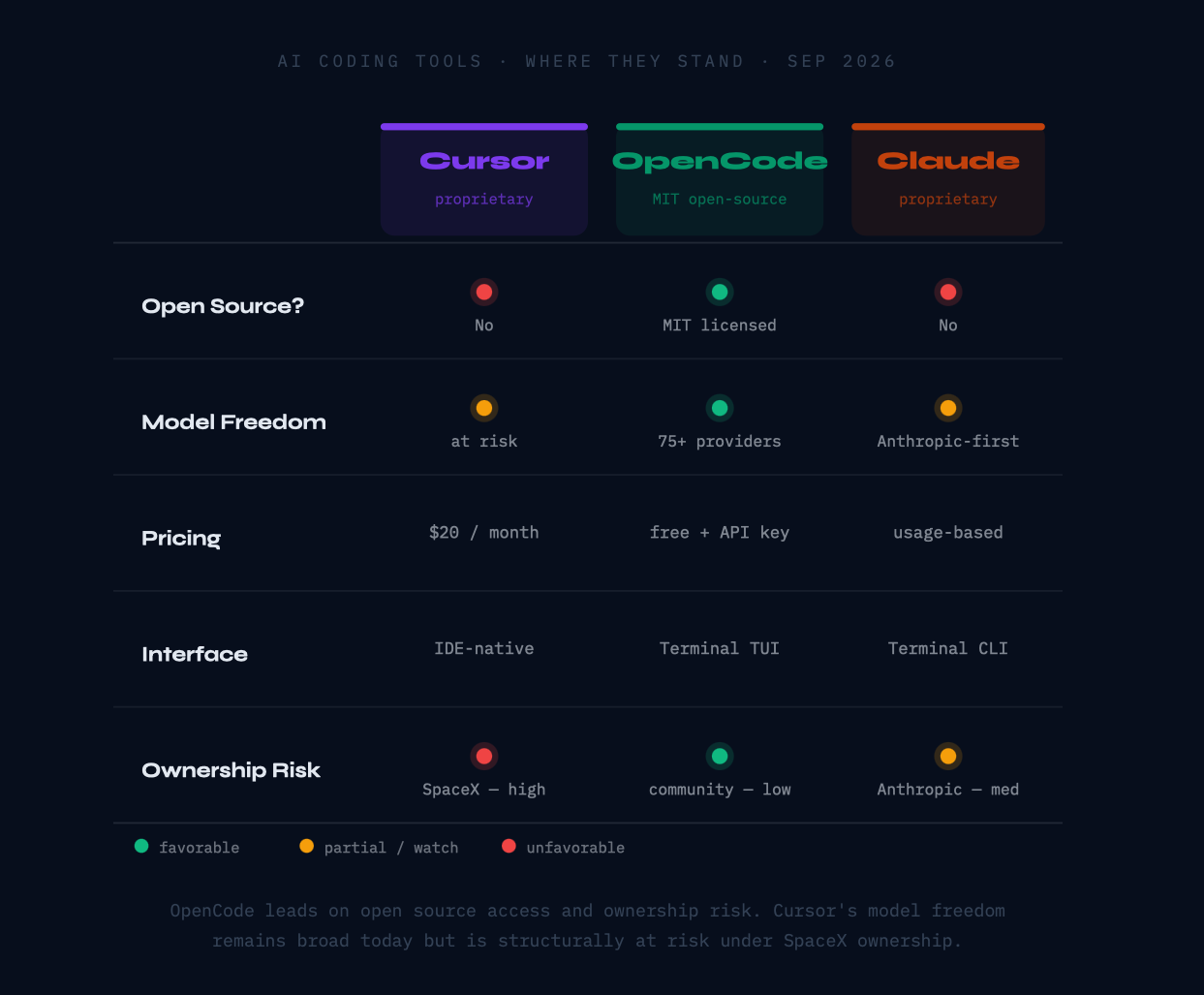
OpenCode is a terminal-first AI coding agent built by the team behind SST (now Anomaly). It's MIT-licensed, runs locally, and connects to 75+ AI providers. If you're the kind of dev who lives in the terminal anyway, it feels surprisingly natural.
# Install OpenCode
npm install -g opencode-ai

# Start a session
opencode

# Inside the TUI, pick your provider
> /model anthropic/claude-opus-4-8

# Ask it to write a Mongoose schema
> write me a User schema with email, hashed password, and refresh token fields
A few things that make it stand out compared to a proprietary IDE plugin:
LSP-powered self-correction: OpenCode pipes compiler diagnostics back into the model context after every file edit. If it writes broken TypeScript, it sees the type error and fixes it before showing you the result. No more "looks right but doesn't compile" moments.
Git-based undo: Every agentic change creates a snapshot. Type /undo to roll back. No more copy-pasting old code from memory because the AI confidently broke something.
Model independence: Because it uses your own API keys, you choose the model per session. For a MERN project you might use Claude Opus for architecture decisions and a cheaper model for boilerplate generation. You control the cost.
# Switch models mid-session
> /model google/gemini-2-5-pro

# Run it in plan-only mode to understand an unfamiliar codebase
> /mode plan
> explain how the auth middleware chain works in this Express app
It's not trying to replace an IDE — it's more like a really capable AI pair programmer that works in your existing terminal setup. If you're already on Neovim or use Claude Code, it slots in naturally.
What You Should Actually Do Right Now
Here's the thing — nobody is saying you need to abandon Cursor tomorrow. If it's working for you, keep using it. The immediate situation is fine.
But this is a good prompt to audit your tooling dependencies:
1. Know what's in your AI context Most developers have never checked what files Cursor is indexing. Go look. Does it have access to your .env files? Your database connection strings? Most enterprise teams should add these to .cursorignore:
.env
.env.*
*.pem
config/secrets.*
2. Experiment with alternatives now, not when you're desperate Spend a Friday afternoon setting up OpenCode or trying Claude Code on a side project. Get the muscle memory before you might actually need it. The worst time to evaluate an alternative tool is when you're mid-sprint and your current one is degrading.
3. If you're on an enterprise plan, ask the right questions Negotiate clauses around third-party model access. Get in writing that you'll receive reasonable notice before major model access changes. Boring, but important.
4. For Python/ML work, this matters too If you're using Cursor for your Python ML scripts alongside your Node.js backend, model quality matters even more. Scientific code tends to benefit from models with stronger reasoning. Locking into a single model family is higher-risk here than for boilerplate generation.
The Bigger Picture
The Cursor acquisition is one more reminder that developer tools are infrastructure. We treat them like free utilities, but someone always owns them — and ownership comes with incentives.
The healthiest thing the community has going for it is that open-source alternatives are genuinely good now. OpenCode isn't a compromise. It's a real tool that some developers are actually preferring over Cursor for workflow reasons, completely aside from the acquisition drama.
If this situation sends more developers toward open-source tooling and model-agnostic workflows, that's honestly not a bad outcome. We've seen this pattern before — AWS lock-in pushed the container ecosystem toward Kubernetes, mobile platform lock-in pushed devs toward cross-platform frameworks. The community adapts.
For now: keep shipping, stay curious, and maybe spend an afternoon poking at OpenCode. Future-you will appreciate having options.
What's your current AI coding setup? Are you sticking with Cursor or exploring alternatives? Drop your thoughts in the comments — I'm genuinely curious where MERN devs land on this.