S&P Global Just Bought Web3's Most Important Security Library — Here's What It Means for Your Stack

If you've ever deployed a smart contract and felt a little nervous about it, you've probably leaned on OpenZeppelin at some point. And last week, S&P Global — yes, the credit ratings S&P Global — announced they're acquiring it. That's not the kind of headline I expected to wake up to either.
But the more I think about it, the more it makes sense. And if you're a MERN dev who's been dipping your toes into Web3, this is genuinely worth paying attention to.
So... What Even Is OpenZeppelin?
For the MERN devs who haven't ventured deep into blockchain territory yet — OpenZeppelin is basically the npm package of the smart contract world, except it's also the security audit firm you'd hire to review your contracts.
Their open-source Contracts library is what most Ethereum and EVM-compatible projects pull in when they need battle-tested implementations of token standards like ERC-20 (fungible tokens), ERC-721 (NFTs), and ERC-1155 (multi-token standard). Think of it like using bcrypt for password hashing or helmet in your Express app — you could write it yourself, but why would you, when someone smarter has already done it and had it audited to death?
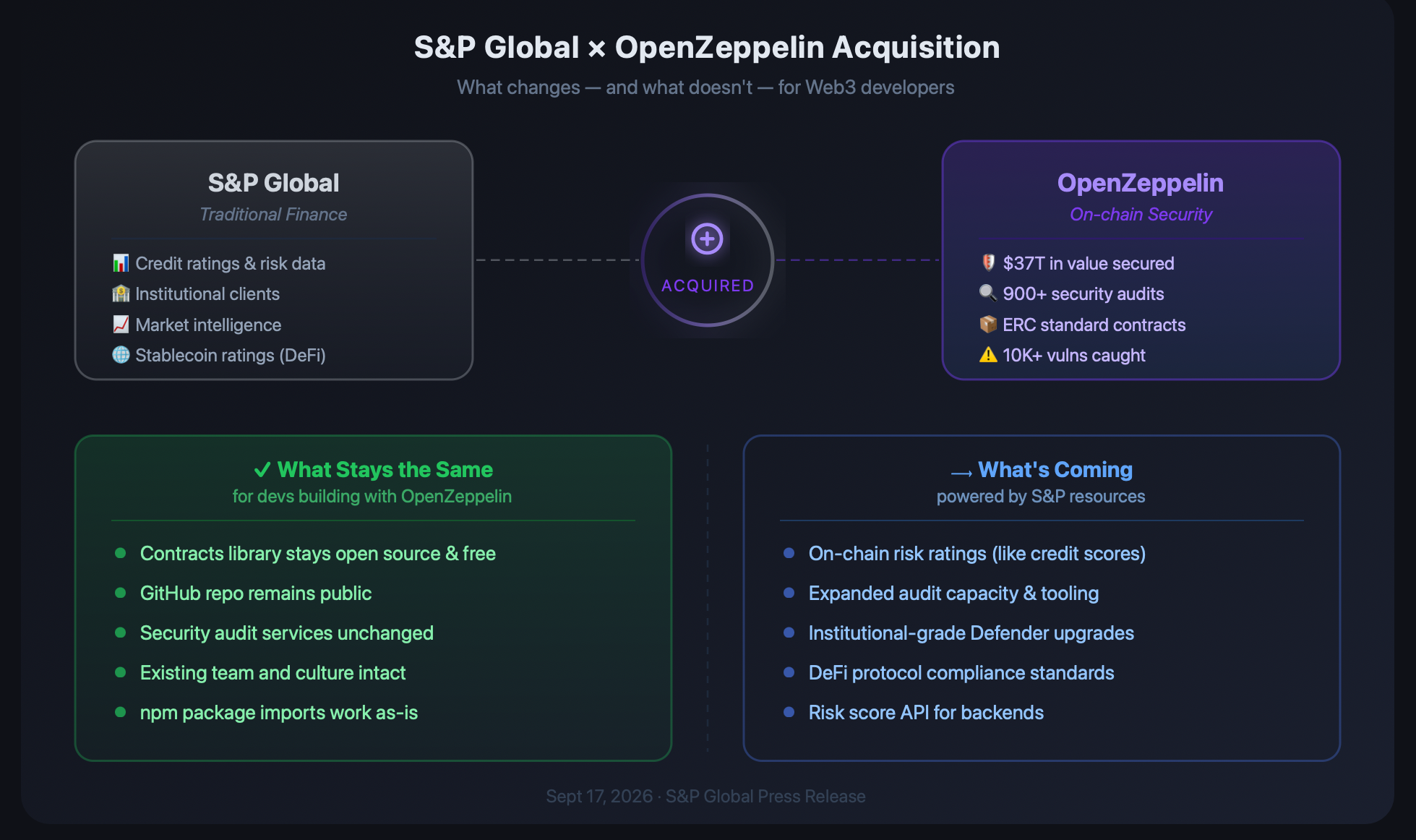
Since 2015, that library has facilitated $37 trillion in value transfers. Stablecoins, tokenized money market funds, DeFi protocols — a huge chunk of on-chain finance runs on OpenZeppelin code. They've also done over 900 security audits and caught more than 10,000 vulnerabilities before those contracts ever hit mainnet.
So this isn't some niche library. It's infrastructure.
What the S&P Deal Actually Means
S&P Global's Ratings division isn't exactly known for deploying Solidity, so their move might seem weird on the surface. But zoom out a bit.
Institutional money has been moving on-chain. Major asset managers are tokenizing treasuries. Stablecoins are being used in settlement. And the one thing every institutional player wants before touching any of this is risk assessment they can trust — the kind that comes with a rating, a grade, a stamp of credibility from someone like S&P.
Here's what their CEO said about the deal:
"Joining S&P Global will take this work to its next stage: the standard our team and community built becomes the standard the next generation of global finance runs on."
That's not marketing fluff — that's a product roadmap. S&P wants to build on-chain risk ratings. And OpenZeppelin's audit infrastructure is exactly the data layer that makes that possible.
What OpenZeppelin committed to keeping unchanged:
All Contracts libraries stay open source and freely available on GitHub
Security audit services continue as-is
The existing team stays intact
So if you're using @openzeppelin/contracts in your project today, nothing breaks. Your imports still work. The GitHub repo doesn't go private.
How This Actually Shows Up in a MERN Project
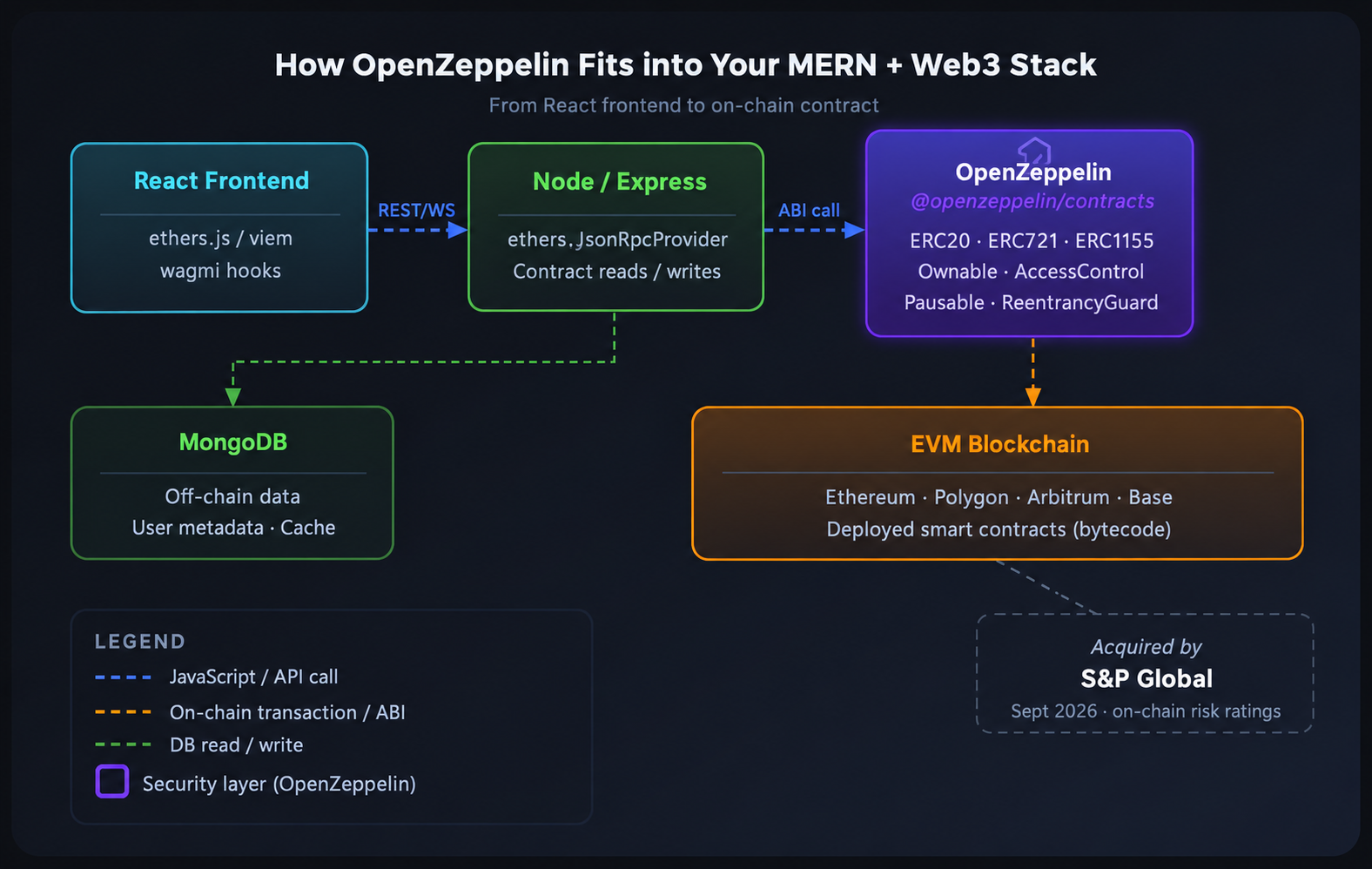
If you're building a MERN app with any kind of on-chain component — whether that's NFT minting, token gating, or DAO governance — here's how OpenZeppelin typically plugs into your stack.
On the smart contract side (Solidity), you're pulling in their contracts:
// SPDX-License-Identifier: MIT
pragma solidity ^0.8.20;

import "@openzeppelin/contracts/token/ERC20/ERC20.sol";
import "@openzeppelin/contracts/access/Ownable.sol";

contract MyToken is ERC20, Ownable {
    constructor(address initialOwner)
        ERC20("MyToken", "MTK")
        Ownable(initialOwner)
    {
        _mint(msg.sender, 1000000 * 10 ** decimals());
    }
}
That's a fully functional ERC-20 token — ownership controls and all — in about 15 lines. No inventing your own transfer logic and introducing a reentrancy bug.
On the Node/Express backend side, you talk to that deployed contract using ethers.js or viem:
// express route — reading token balance
import { ethers } from "ethers";
import TokenABI from "./abis/MyToken.json" assert { type: "json" };

const provider = new ethers.JsonRpcProvider(process.env.RPC_URL);
const contract = new ethers.Contract(
  process.env.TOKEN_ADDRESS,
  TokenABI,
  provider
);

app.get("/balance/:address", async (req, res) => {
  try {
    const balance = await contract.balanceOf(req.params.address);
    res.json({ balance: ethers.formatEther(balance) });
  } catch (err) {
    res.status(500).json({ error: "Failed to fetch balance" });
  }
});
The ABI you're importing? That comes directly from compiling your OpenZeppelin-based contract. React on the frontend then calls this Express endpoint, keeping your RPC credentials server-side where they belong.
What the Acquisition Changes for Security-Minded Devs
Here's where it gets interesting for those of us who care about the security side.
Right now, if you wanted an OpenZeppelin audit, you were on a waiting list and paying enterprise rates. Post-acquisition, S&P Global's resources are going into expanding that capacity. More auditors, more tooling, more automated analysis — all backed by an institution that literally exists to rate risk.
What I'm watching for:
Automated on-chain risk scoring — imagine something like a credit rating for a smart contract or DeFi protocol, surfaced as an API you can call from your backend
Tighter integration with Defender (OpenZeppelin's contract monitoring/admin tool) now that institutional resources are behind it
More formal security standards as tokenized assets face regulatory scrutiny — OpenZeppelin's standards becoming the benchmark for compliance audits
For a MERN dev building any kind of DeFi or tokenization product, this could mean a future where your backend calls an API to get an S&P-rated risk score on the contract your app is about to interact with. That's not science fiction anymore.
What You Should Take Away From This
This deal is a signal, not just a transaction. Traditional finance doesn't spend money acquiring blockchain infrastructure companies because it's trendy — they do it because they're betting the plumbing of global finance is moving on-chain and they want to own a critical piece of it.
For MERN devs, a few practical takeaways:
Keep using OpenZeppelin contracts. Nothing's broken. If anything, they'll be better resourced and more regularly audited.
Start treating smart contract security the way you treat backend security. If you wouldn't ship an Express API without input validation and rate limiting, you shouldn't deploy a contract without at minimum running it against OpenZeppelin's audit checklist or their Defender tooling.
Get familiar with the security patterns. The Ownable, Pausable, and AccessControl patterns in OpenZeppelin aren't just convenience — they're the idiomatic way to write upgradeable, governable contracts. Learn them now before the ecosystem demands them as table stakes.
The institutional world just validated the infrastructure the open-source blockchain community has been building for a decade. That's worth paying attention to.
What do you think about traditional finance moving into blockchain infrastructure? Are you already using OpenZeppelin in your stack? Drop your thoughts in the comments.