Node.js in 2026: Three Features That Actually Change How You Work
If you've been heads-down shipping features and haven't had time to track what's happening with Node.js itself, I get it. But there are a few things that landed in the Node 24/26 cycle that are genuinely worth a look — not because they're shiny, but because they're practical enough to change how you structure a project today.
I've been poking at these in a real Express/React monorepo over the past few weeks, and here's what actually held up.
Native TypeScript Execution (Finally — Sort Of)
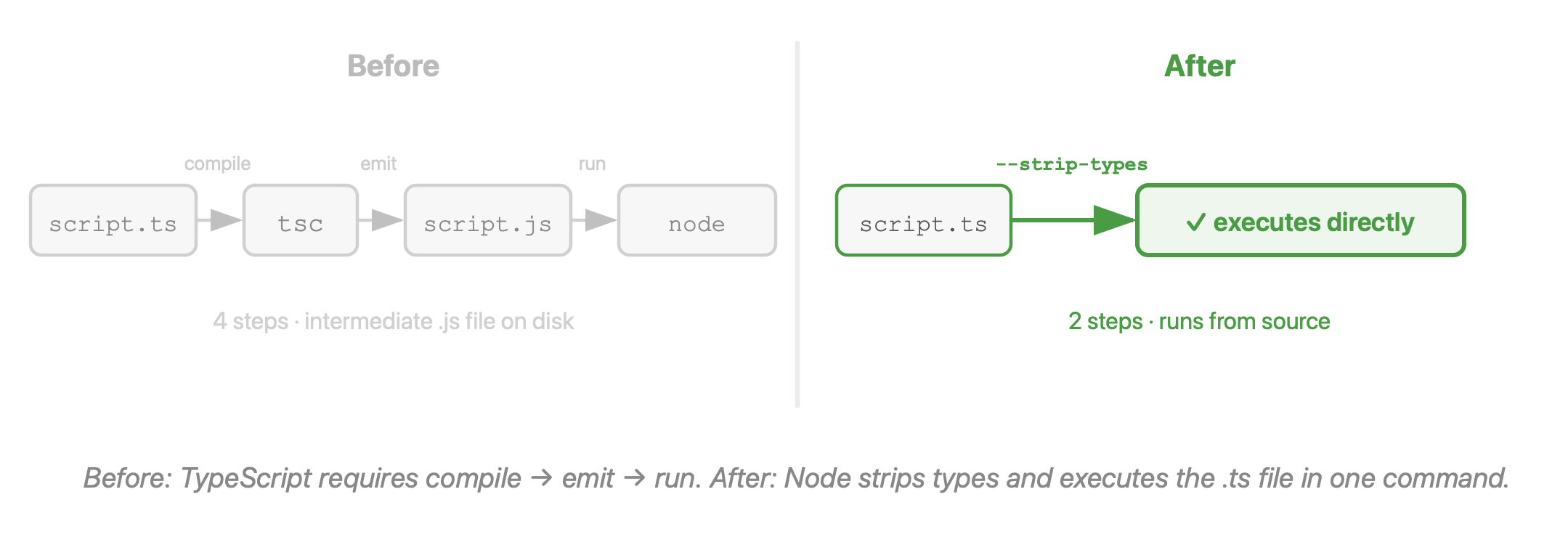
The big one everyone keeps talking about: you can now run TypeScript files directly with Node.js.
node --experimental-strip-types ./scripts/seed-db.ts
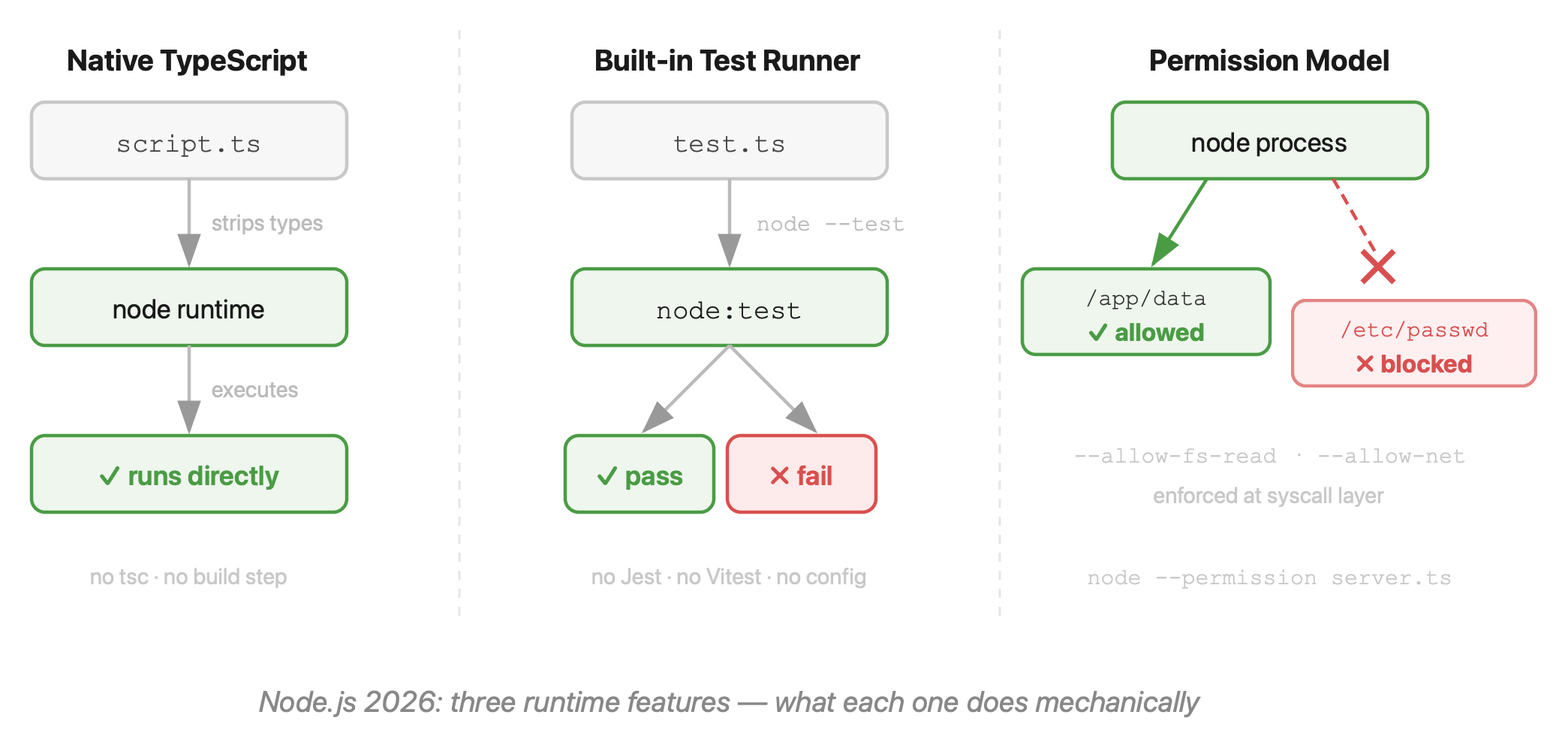
Node strips the type annotations at runtime and executes the resulting JavaScript. No ts-node, no tsx, no compile step in between. For a MERN dev, this is particularly useful for your one-off scripts — database migrations, data seeders, admin utilities — the stuff you've been writing in plain JS just because you didn't want to wire up a build step.
The catch — and this is worth saying clearly — is that Node strips types, it does not check them. You can write complete nonsense in your type annotations and Node will run it just fine. So you still need your CI pipeline to run tsc --noEmit for actual type safety. Think of it less as "TypeScript support" and more as "no transpilation needed for running files." That distinction matters.
For a backend Express service that's already in TypeScript, your deploy pipeline stays mostly the same. Where this shines is for Python-style scripting — the ability to just run a .ts file the same way you'd run a .py script without any intermediate step. If you've been envying Python devs for the "just run it" experience, this closes the gap significantly for server-side utilities.
// scripts/backfill-user-slugs.ts
import mongoose from 'mongoose';
import { User } from '../src/models/User';

await mongoose.connect(process.env.MONGO_URI!);
const users = await User.find({ slug: { $exists: false } });
for (const user of users) {
  user.slug = user.name.toLowerCase().replace(/\s+/g, '-');
  await user.save();
}
console.log(`Updated ${users.length} users`);
await mongoose.disconnect();
Just run node --experimental-strip-types scripts/backfill-user-slugs.ts. Done.
The Built-in Test Runner is Actually Usable Now
Node has had a node:test module for a while, but honestly it felt half-baked for a long time. In 2026, it's at a point where I'd call it production-quality for backend code.
import { test, describe } from 'node:test';
import assert from 'node:assert/strict';
import { createUserSlug } from '../src/utils/slug';

describe('createUserSlug', () => {
  test('converts spaces to hyphens', () => {
    assert.equal(createUserSlug('John Doe'), 'john-doe');
  });

  test('strips special characters', () => {
    assert.equal(createUserSlug('hello@world!'), 'helloworld');
  });
});
Run it with:
node --test
# or watch mode:
node --test --watch
# or with coverage:
node --test --experimental-test-coverage
Parallel by default, watch mode built in, coverage built in. For pure Node.js utility functions, Express route handlers, and Mongoose model logic, this is everything you need.
Now, should you rip out Vitest or Jest from your React project? Probably not. The built-in runner doesn't have jsdom, Vite integration, or the snapshot testing ecosystem that front-end testing depends on. Keep Vitest for React component tests. But for the src/utils, src/services, and src/middleware folders in your Express app, node:test might be all you need — and you'd drop one or two fewer dependencies.
The Permission Model: Security Feature You're Probably Not Using
This one doesn't get as much hype as native TypeScript, but for MERN devs building production apps it might be the most impactful of the three.
The Node.js Permission Model lets you specify exactly what filesystem paths and network hosts your Node process is allowed to touch:
node --permission \
  --allow-fs-read=/app/src,/app/node_modules \
  --allow-fs-write=/tmp,/app/logs \
  --allow-net=api.stripe.com,api.sendgrid.com \
  server.ts
If your app tries to read from /etc/passwd, write to an unexpected directory, or open a connection to an unknown host — the runtime blocks it. Hard, at the syscall layer.
Why does this matter for a MERN app? Two scenarios:
1. Webhook handlers. A lot of Express services handle webhooks from third-party services, process the payload, and fire off some side effects. With the permission model, you can lock down that route handler so it can only write to your DB connection and only call your internal notification service — even if a dependency in your chain has a vulnerability that tries to exfiltrate data.
2. Plugin/agent execution. If you're building anything where user-defined code or external agent scripts run in your Node process (think: AI coding assistants, no-code automation builders, blockchain smart contract interaction scripts), the permission model gives you a runtime sandbox without spinning up a separate container. This is especially relevant as more MERN apps start wiring up AI agent pipelines where the agent can execute tool calls.
# Running an AI agent tool handler with restricted permissions
node --permission \
  --allow-net=api.openai.com \
  --allow-fs-read=/app/data/allowed \
  agent-tool-runner.ts
It's not a perfect sandbox — it's enforced at the Node API boundary, not a full OS-level isolation — but it's a meaningful layer of defense that costs you almost nothing to add.
One More: Temporal API is Now On by Default
Node 26 ships with the Temporal API enabled by default. If you've been living with Date quirks for years — timezone handling, DST bugs, the mess of toLocaleDateString() — Temporal is the proper fix that's been in the works forever.
import { Temporal } from '@js-temporal/polyfill'; // no longer needed in Node 26!

const meeting = Temporal.ZonedDateTime.from({
  year: 2026,
  month: 9,
  day: 18,
  hour: 14,
  timeZone: 'America/New_York',
});

const inTokyo = meeting.withTimeZone('Asia/Tokyo');
console.log(inTokyo.toString()); // 2026-09-19T03:00:00+09:00[Asia/Tokyo]
For MERN apps that deal with scheduling, multi-timezone user data, or anything where date math currently feels fragile, this is worth a look. It's not a rewrite-your-whole-app change, but for greenfield features, reach for Temporal instead of Date and save yourself some future pain.
What This Means in Practice
The Node.js 2026 story isn't a revolution — it's a quiet, steady maturation. Here's my honest take on what to actually do:
Start using
node:testfor your Express and Mongoose logic right now. It's stable, it's fast, and it's one fewer thing to configure.Use
--experimental-strip-typesfor scripts and utilities where you just want to run TypeScript without a build step. Keep yourtsccheck in CI.Add
--permissionflags to at least your webhook handlers and any route that calls third-party APIs. It's a one-liner with real security upside.Play with Temporal in your next date-heavy feature instead of reaching for
date-fnsordayjs.
None of these are breaking changes. You can try them incrementally, in isolation. That's the nice thing about how Node has been shipping lately — it doesn't force your hand. But the features are genuinely good, and for a MERN stack developer, they hit in the right places.
If you're building something that uses the Node permission model for AI agent sandboxing or you've had interesting results with the native TS runner, I'd love to hear about it in the comments. These are the kinds of practical details that are hard to find written down anywhere.