Node.js Security Releases Hit All Active Lines Today — The MERN Dev's Patching Checklist
If you woke up this morning, opened your GitHub notifications, and found a security advisory from the Node.js team — you're not alone. Today, October 21, 2026, the Node.js project dropped security patches across all three of its active release lines: 22.x, 24.x, and 26.x. The highest severity in each? HIGH. That means if you're running a Node.js backend — and if you're a MERN dev, you almost certainly are — this warrants actual attention, not a "I'll get to it next sprint" snooze.
Let me walk you through what we know, how to patch quickly, and how to make sure this doesn't catch you off guard next time.
What Actually Happened
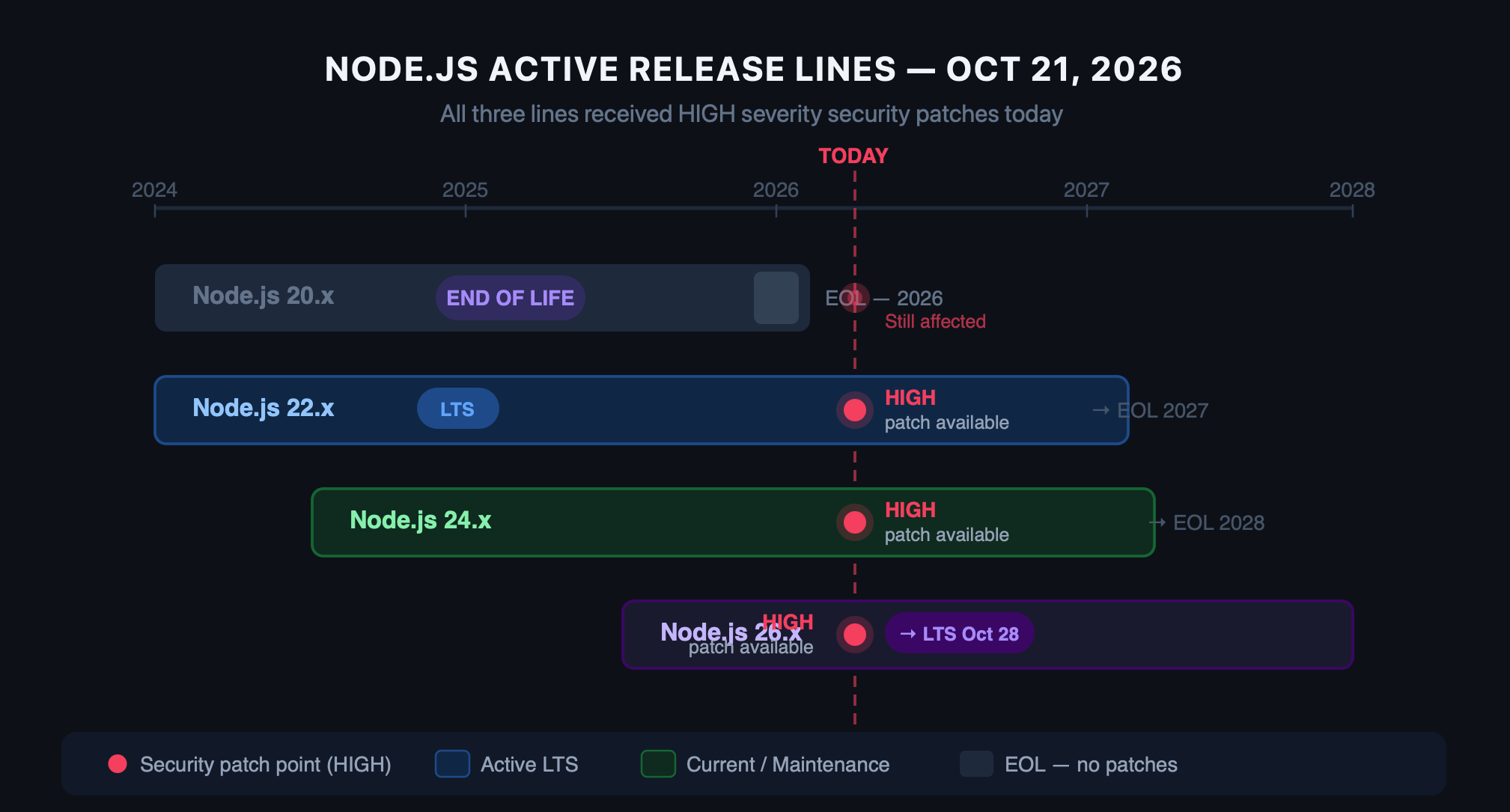
The Node.js project published its October 2026 security release announcement covering:
Node.js 26.x — HIGH severity
Node.js 24.x — HIGH severity
Node.js 22.x (LTS) — HIGH severity
The advisory doesn't list specific CVE IDs ahead of the actual patch release (standard practice — they don't want to hand attackers a roadmap before fixes are widely deployed), but the fact that every supported line is affected at HIGH severity tells you this isn't a minor edge-case bug. These releases are shipping on or around today, so the patched versions should be available by the time you're reading this.
One more thing buried in the advisory that's easy to miss: End-of-Life versions are always affected when a security release occurs. If you're still running Node.js 18.x or 20.x anywhere in production — and I know some of you are — you're exposed with no patch coming. That's the kick to finally migrate.
Patching Your MERN Stack Right Now
Here's the practical stuff. Whether you're running Node on a VM, in Docker, or on a managed service, the flow is roughly the same.
Check what you're on first
node --version
# v24.x.x or v22.x.x or v26.x.x?
Then check if a patched version is already available:
# If you use nvm (which you should)
nvm ls-remote --lts | tail -10
nvm install 22      # pulls latest 22.x patch
nvm use 22
Or with fnm, which is increasingly common in 2026:
fnm install 22
fnm use 22
In Docker
Update your Dockerfile base image. If you're pinning to a specific minor, bump it:
# Before
FROM node:22.18.0-alpine

# After — pull latest patch in the 22.x line
FROM node:22-alpine
Or better yet, pin to the digest once you've verified the patched image is published:
docker pull node:22-alpine
docker inspect node:22-alpine --format='{{index .RepoDigests 0}}'
# Use this digest in your FROM
Rebuild and redeploy. If you're on a CI/CD pipeline (and you should be), kick it off now rather than waiting for the next code push.
On managed platforms (Railway, Render, Fly.io, etc.)
Most of these let you specify a Node.js version in a config file or environment variable. Check your package.json engines field:
{
  "engines": {
    "node": ">=22.0.0 <23"
  }
}
And update your platform's runtime setting to pull the latest 22.x. If you're on Fly.io, redeploy with:
fly deploy
The platform will pull the updated base image on the next deploy.
Setting Up Automated Security Monitoring (So You're Not Always Reactive)
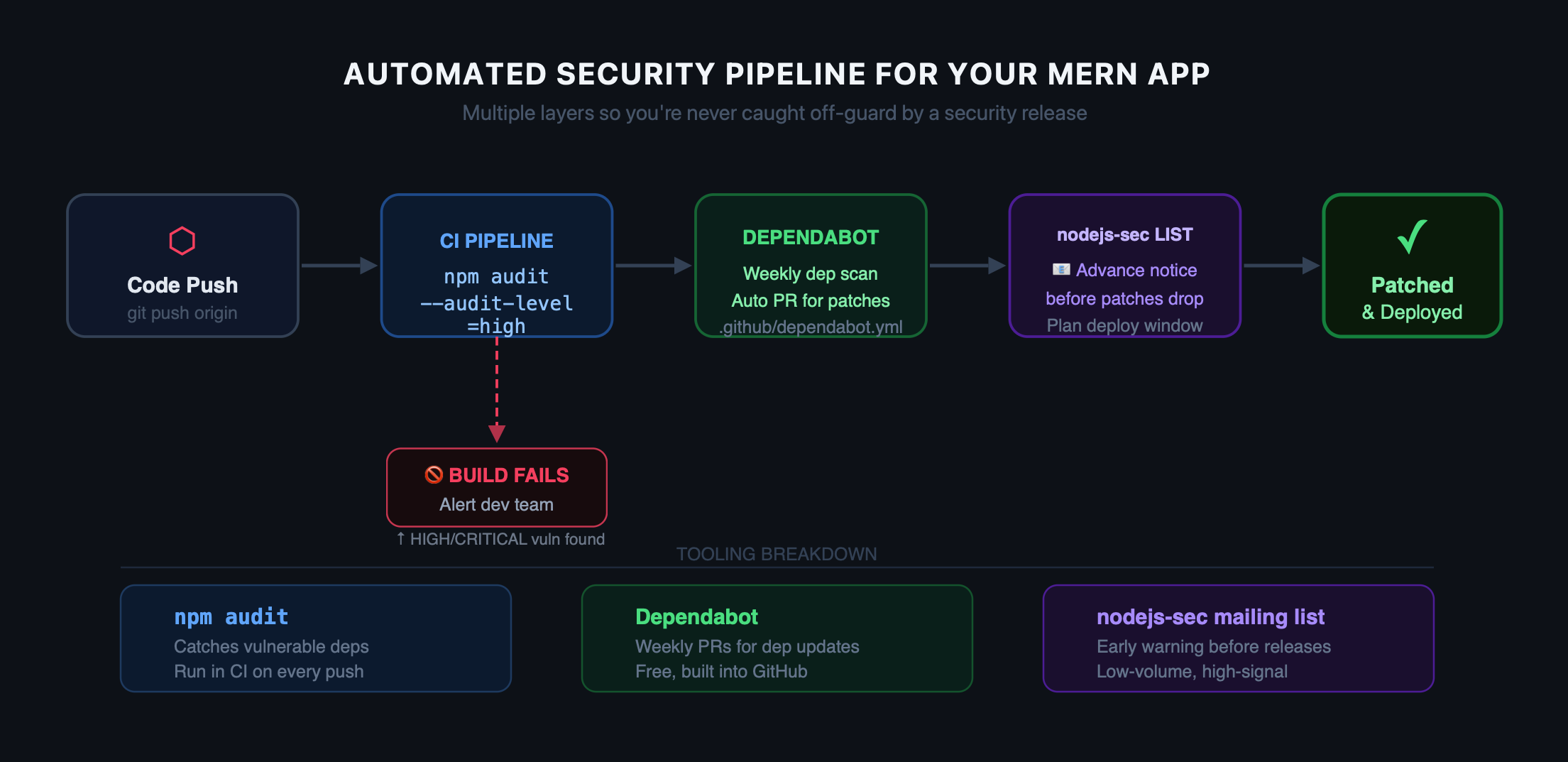
Here's the honest truth: the reason most MERN teams scramble when a release like this drops is that they don't have any automation watching for it. Let me fix that for you.
1. npm audit in your CI pipeline
This should be a non-negotiable step in every pipeline run:
# GitHub Actions example
- name: Security audit
  run: npm audit --audit-level=high
The --audit-level=high flag will fail the build on high or critical vulnerabilities. Some teams set this to moderate — find the threshold that works for yours, but don't leave it unset.
2. GitHub Dependabot
Add a .github/dependabot.yml to your repo if you don't have one:
version: 2
updates:
  - package-ecosystem: "npm"
    directory: "/"
    schedule:
      interval: "weekly"
    open-pull-requests-limit: 10
Dependabot will automatically open PRs when new versions of your dependencies drop — including security patches. It's not perfect but it gives you visibility without manual babysitting.
3. Subscribe to nodejs-sec
This one's low-tech but underrated. The Node.js team maintains a low-volume mailing list specifically for security announcements:
https://groups.google.com/forum/#!forum/nodejs-sec
Subscribe with your work email. You'll get advance notice (usually a few days) before security releases drop, which gives you time to plan a deployment window instead of doing emergency patches on a Wednesday morning.
The Bigger Picture: Runtime Security Is Part of Your Stack
A lot of MERN developers think about security in terms of their application code — input validation, auth, SQL injection. That's right to focus on, but your runtime is part of your attack surface too. A vulnerable Node.js binary can expose your entire Express backend to exploitation before your application code even runs.
The mental model I'd suggest: treat your Node.js version the same way you treat your npm dependencies. You wouldn't run an app with [email protected] flagged by npm audit and just ignore it. Don't do that with the runtime either.
A few things worth adding to your operational checklist:
Tag your Docker images with Node.js versions.
node:22-alpineis convenient but opaque.node:22.19.1-alpinetells you exactly what runtime you're on.Run
npm auditlocally before pushing, not just in CI. Catch it early.Know when your Node.js version goes EOL. The release schedule lives at
https://github.com/nodejs/release. Set a calendar reminder 3 months before EOL so you're not scrambling at the last minute.If you're writing any Go services alongside your Node backend — and the Go 1.27 release earlier this year made a lot of MERN teams start experimenting — Go's runtime patching story is simpler but the same discipline applies. Subscribe to the Go security list too.
TL;DR — What to Do Today
Run
node --versionand confirm you're on a supported release line (22.x, 24.x, or 26.x)Update to the latest patch in your line — via nvm, fnm, Docker, or your platform
Redeploy or restart your Node.js process
If you're on EOL (18.x, 20.x), upgrade your release line — not just the patch
Add
npm auditto your CI pipeline if it's not thereSubscribe to nodejs-sec for advance warnings next time
Security patches aren't exciting. But a Tuesday-morning deploy to patch a HIGH severity vulnerability is a lot better than a Friday-night incident. Patch now, sleep better this weekend.
Got your MERN stack patched? Drop a comment below — and if you've been putting off that Node.js 20 → 22 upgrade, today's your sign.
About the author
- Love to code, gaming. And I use vim btw.
Comments
Join the discussionNo comments yet. Be the first to comment.