Zod 4.5 Just Made Your MERN Stack Validation 9x Leaner — Here's What Changed

If you're building anything serious with a MERN stack, Zod is probably doing quiet, thankless work somewhere in your codebase — validating request bodies in Express, shaping API responses before they hit your React components, or type-guarding data coming out of MongoDB. It works, it's typed, and you probably haven't thought about it much. That changes with Zod 4.5.
This release dropped in mid-October 2026 and brings something genuinely interesting to the table: in-process schema compilation. We're talking 3–9x faster parsing and a 9x cut in memory per schema instance. For most apps you won't feel a thing — but once your Express service is handling serious load, you'll care. A lot.
What's Actually Happening with z.compile()
The headline feature is z.compile(). Wrap any schema in it and you get back a functionally identical schema that's been pre-compiled:
import { z } from "zod";

const UserSchema = z.object({
  name: z.string().min(2),
  email: z.string().email(),
  role: z.enum(["admin", "user", "guest"]),
});

// Compiled version — drop-in replacement
const CompiledUserSchema = z.compile(UserSchema);

// Works exactly the same way
const result = CompiledUserSchema.safeParse(req.body);
The difference shows up in benchmarks. A 20-key object schema that used to take ~301 ns per parse now clocks in at ~38 ns after compilation. That's roughly 8x. For a single request it's nothing. For an Express route hitting 10,000 requests per second, it's suddenly very relevant.
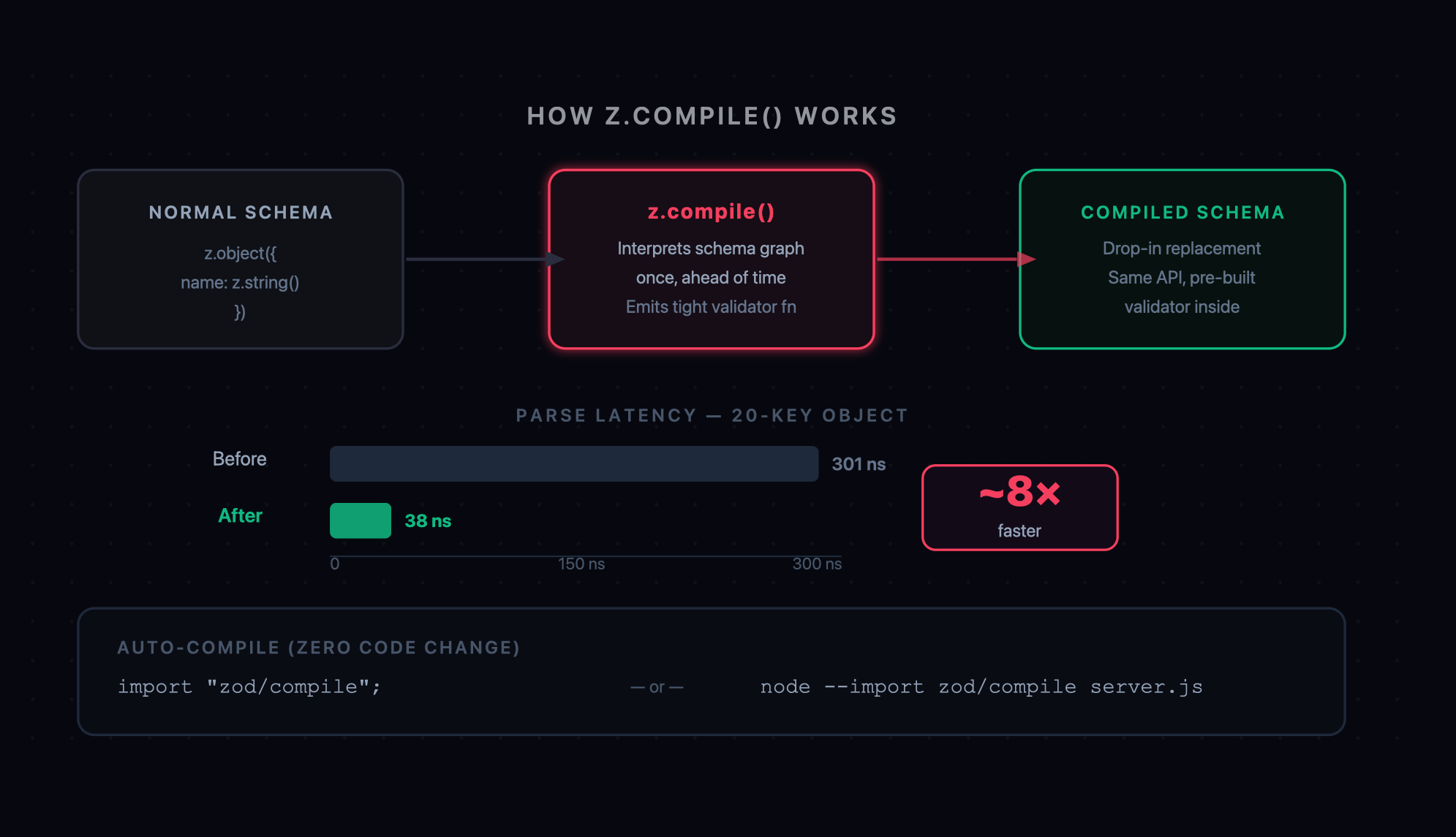
The reason it's faster is that z.compile() does the work of interpreting the schema graph ahead of time and emits a tight validator function. Normal Zod schemas are traversed dynamically on every parse call. Compilation sidesteps that traversal.
The Lazy Option: Auto-Compile Everything
If you don't want to wrap every schema manually (fair), there's a shortcut:
// Add this at the top of your entry point — server.ts, index.ts, wherever
import "zod/compile";

// Every schema constructed after this import is auto-compiled on first parse
const UserSchema = z.object({ name: z.string(), age: z.number() });
// ↑ compiled automatically the first time .parse() or .safeParse() is called
You can also apply it without touching source files:
# Node.js
node --import zod/compile dist/server.js

# Bun
# In bunfig.toml:
# preload = ["zod/compile"]
This is a zero-code-change win for existing Express/Node apps. Drop in the import and re-deploy. Worth benchmarking before and after on anything compute-heavy.
The Memory Story Is Just as Good
Schema compilation gets the headlines, but the memory improvements are almost more interesting. In Zod 4.4 and below, a bare z.string() holds onto about 7.53 KB of memory. In 4.5, that same schema sits at 784 bytes — roughly a 9x reduction.
The reason: previously, every schema instance eagerly allocated bound method references (.parse, .safeParse, .refine, etc.) at construction time. Now those methods are memoized — they're only allocated the first time you actually call them.
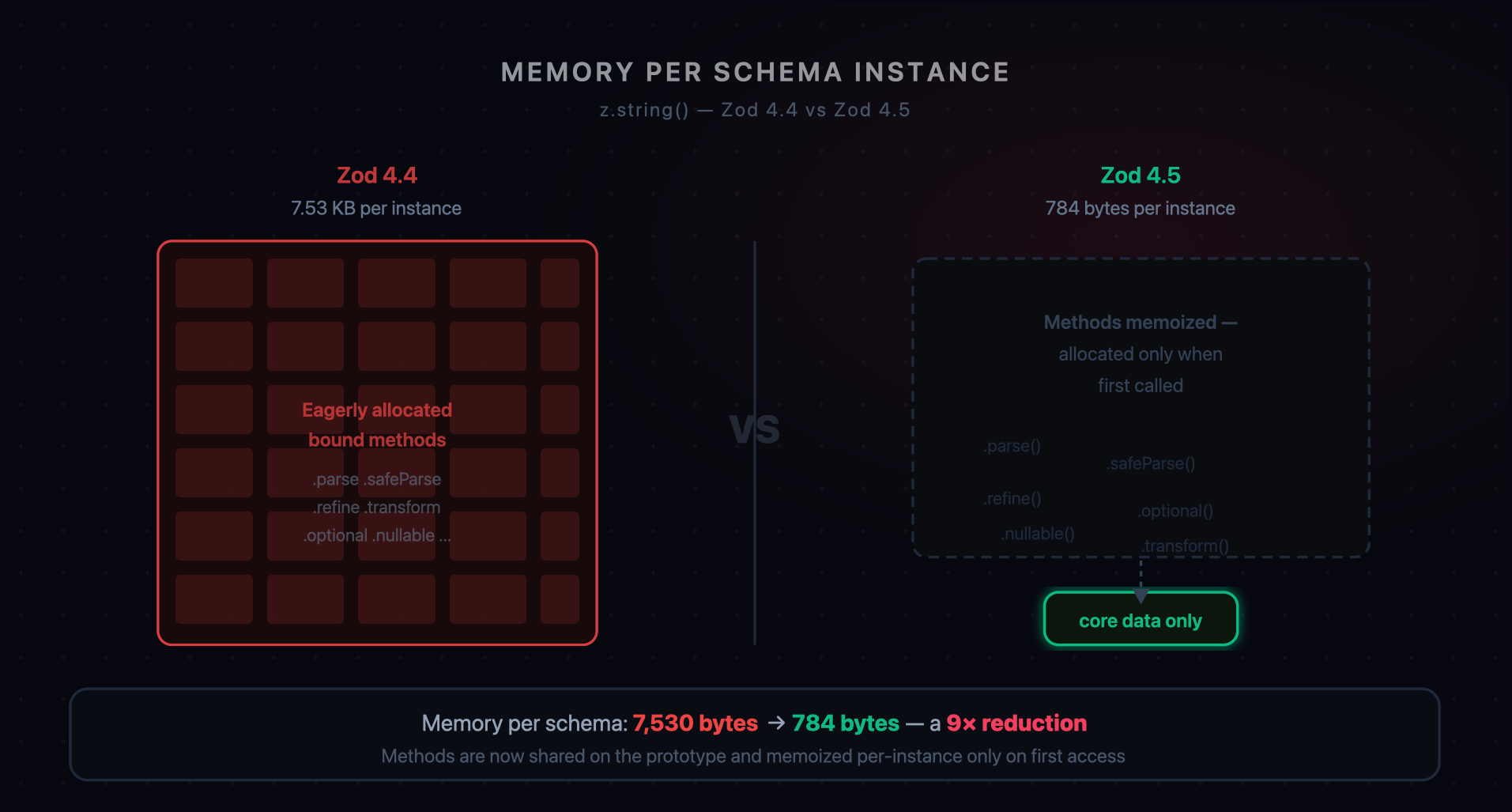
On a small app this barely matters. But if you're constructing schemas dynamically, creating many per-request schema instances, or running a high-throughput API, this adds up. Less GC pressure, lower baseline memory, fewer surprises at scale.
There's also a separate win for error paths: safeParse() failures are now ~7.6x faster because ZodError no longer eagerly captures a stack trace. Stack traces are expensive. Zod used to always pay that cost, even when you just wanted a structured error object and didn't need the trace at all.
New APIs Worth Knowing
4.5 also ships several new schema types and utilities that are genuinely useful:
z.creditCard() — validates 12–19 digit card numbers using Luhn checksum. If you're building any payment UI in React, this is one less thing to write yourself.
const CardSchema = z.object({
  number: z.creditCard(),
  cvv: z.string().length(3),
  expiry: z.string().regex(/^\d{2}\/\d{2}$/),
});
z.deepPartial() and z.exactPartial() — deepPartial recursively makes all fields optional, which is handy for PATCH endpoints in Express. exactPartial is the strict variant: fields can be absent but not explicitly undefined.
// Perfect for PATCH /users/:id
const UpdateUserSchema = z.deepPartial(UserSchema);

// Rejects { name: undefined } — must be omitted, not set to undefined
const StrictUpdateSchema = z.exactPartial(UserSchema);
z.input() and z.output() — project a schema onto its input or output type. Useful when you have transforms and need to work with the pre-transform type in another schema.
Breaking Changes You Need to Catch
A few soundness fixes in 4.5 will silently reject inputs that used to pass. Check these against your existing validation logic:
Datetime strictness — z.iso.datetime() now requires seconds. "2020-01-01T06:15Z" is no longer valid. If you're storing datetimes without seconds anywhere (calendar events, log timestamps), you'll need to use precision: -1 in a union:
// Before: z.iso.datetime() — now rejects datetimes without seconds
// After:
const FlexibleDatetime = z.union([
  z.iso.datetime(),
  z.iso.datetime({ precision: -1 }),
]);
String length counting — .min(), .max(), and .length() now count Unicode code points instead of UTF-16 code units. This matters for emoji and non-BMP characters. An emoji like 🔥 is one code point but two UTF-16 units — so .max(5) will now allow five emoji where it previously only allowed around two-and-a-half. Update any length constraints that deal with user-generated content.
Proto pollution protection — __proto__ keys are always stripped now, and .strict() reports them as unrecognized. This is a security win, not something you need to work around.
Should You Upgrade Today?
Honestly? If you're already on Zod v4.x, yes — the migration path is minimal. The breaking changes above are edge cases most apps don't hit. Run your test suite, grep for .iso.datetime() calls and string length validators on emoji-capable fields, and you're probably good.
If you're on Zod v3 and haven't migrated to v4 yet, this is a good excuse. The v3 → v4 migration has more friction, but v4's performance baseline is already much better, and 4.5 pushes it further.
The z.compile() feature is marked canary-only in the official release notes, so treat it as opt-in for now — but the memory improvements and the error path speedups are stable and on by default. You get those just by upgrading the package.
npm install zod@latest
Run your validation tests. If they still pass, ship it. Zod 4.5 is one of those quiet upgrades that makes your app measurably better without asking much from you in return.