Your AI Copilot Writes Code Faster — But Two New Surveys Say You're Debugging More Than Ever

You adopted AI coding tools to ship faster. You're probably writing code faster. But two surveys that dropped this week suggest you might actually be releasing at the same pace as before — because all that saved writing time is now getting eaten up on the other end, in debugging.
That's the uncomfortable finding buried in the data, and if you're a MERN developer leaning on Copilot, Cursor, or Claude to generate your Express routes and React hooks, it's worth sitting with for a minute.
The Numbers Are Actually Kind of Alarming
The first survey comes from Undo (a debugging tools company — yes, they have skin in the game, but the numbers are independently consistent). They commissioned Coleman Parkes to survey 300 senior engineering leaders. Here's what came back:
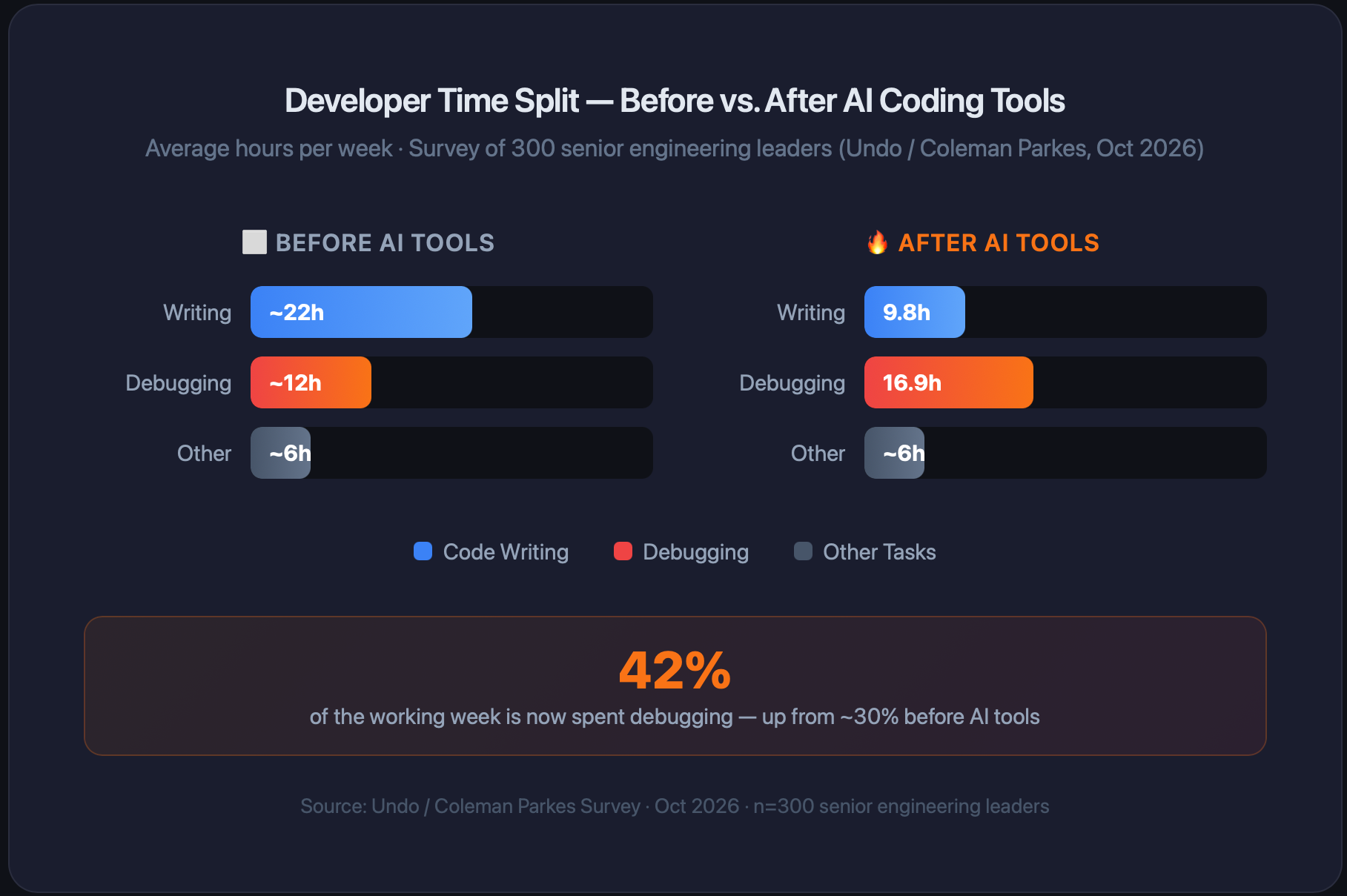
Teams spend an average of 9.8 hours per week producing code and 16.9 hours per week debugging — about 42% of the working week
81% experienced a production incident or outage in the last six months
93% experienced incorrect root-cause diagnosis from AI hallucination, with 18% hitting this multiple times per month
79% say AI agents generate code significantly faster, but the overall release speed hasn't changed
The second survey, from Lightrun (also a debugging tool vendor, also note that), polled 200 senior SRE and DevOps leaders at large enterprises across the US, UK, and EU. Their numbers hit harder:
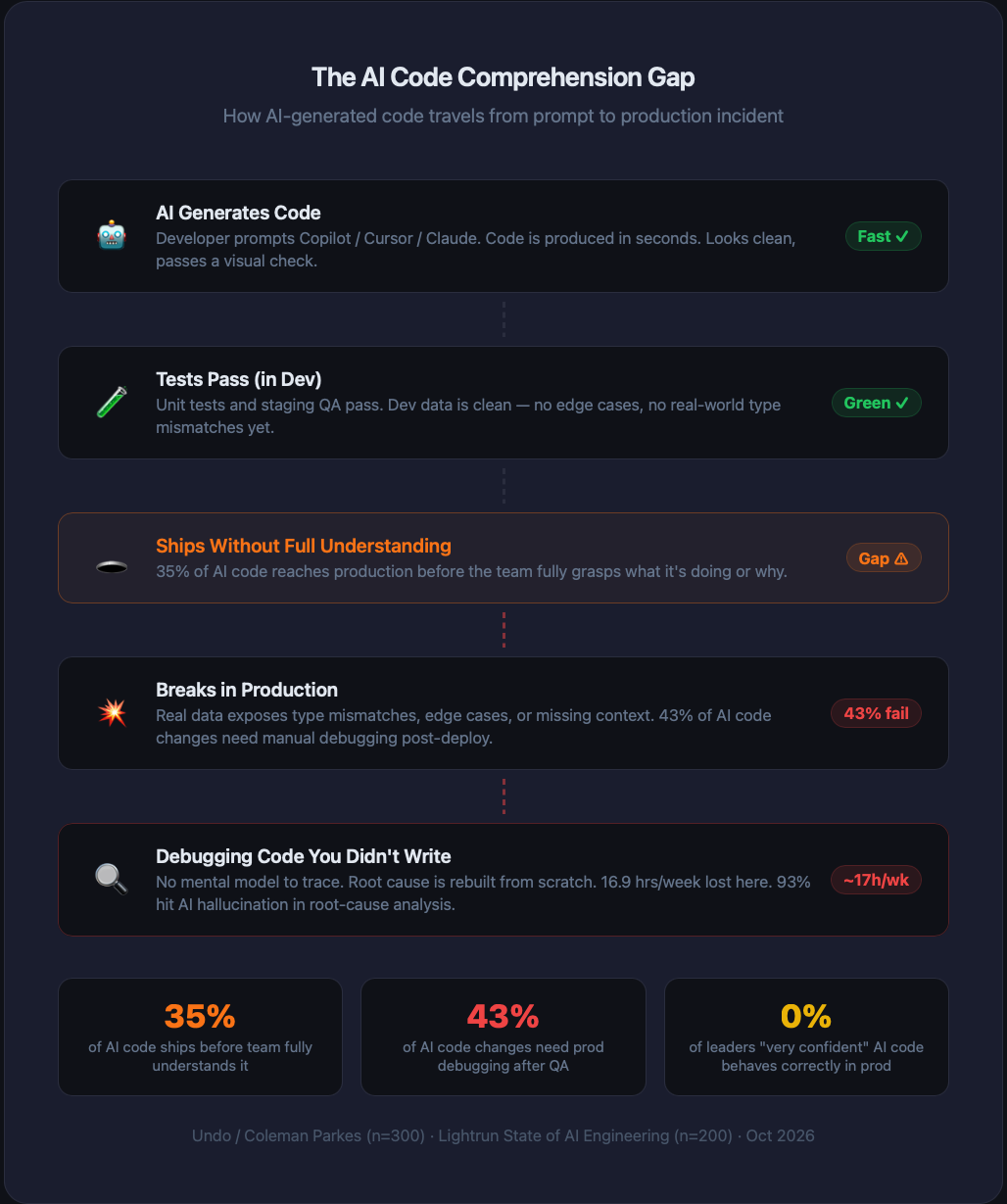
43% of AI-generated code changes need manual debugging in production, even after passing QA and staging tests
Zero respondents said they were "very confident" that AI-generated code would behave correctly once deployed
Not a single organization has moved AI SRE tools into actual production workflows — 90% are still in experimental or pilot mode
38% of the average developer's week (roughly two full days) is spent on debugging, verification, and environment-specific troubleshooting
When two separate surveys from two separate companies with two separate sample populations land on nearly identical conclusions — you pay attention.
The Comprehension Gap Is the Real Problem
Here's what I think is the most underreported finding in the Undo survey: 35% of AI-generated code reaches production before the team has fully understood it.
Think about what that means in practice. You ask Copilot to write a Mongoose aggregation pipeline. It looks right. The tests pass. You ship it. Three weeks later something breaks in prod and nobody — including the person who "wrote" it — can tell you exactly why that $lookup is joining on that field or why there's a $unwind before the $group.
This is the comprehension gap. It's not that the code is wrong at generation time. It's that the act of generating it skips the mental model-building that would normally happen when you write it yourself. You debug code you wrote by tracing through the logic you already understand. You debug code your AI wrote by reconstructing the logic from scratch, under pressure, at 2am.
The survey respondents described engineers no longer having the "inherent understanding they once did." That's a real thing. I've felt it on my own projects.
What This Looks Like in a MERN Stack
Let me make this concrete. Here's a pattern I've seen go sideways:
// AI-generated Express route with a subtle production bug
router.get('/dashboard', authenticate, async (req, res) => {
  try {
    const [metrics, recentOrders] = await Promise.all([
      Metric.aggregate([
        { $match: { userId: req.user.id, createdAt: { $gte: startOfMonth() } } },
        { $group: { _id: '$type', total: { $sum: '$value' } } }
      ]),
      Order.find({ userId: req.user.id })
        .sort('-createdAt')
        .limit(10)
        .populate('items.product')
    ]);

    res.json({ metrics, recentOrders });
  } catch (err) {
    res.status(500).json({ error: 'Something went wrong' });
  }
});
The code looks clean. Tests pass. Then in production, with real data, req.user.id is a string but the aggregation $match needs an ObjectId. It works in dev because your test data has no cross-type mismatches. It silently returns empty arrays in prod for some users. Support tickets start rolling in.
The fix is one line:
{ $match: { userId: new mongoose.Types.ObjectId(req.user.id), ... } }
But finding that line in a route you didn't mentally author? That's where the 43% debugging rate comes from. The AI didn't make a conceptual mistake — it just didn't know about your data's actual shape at runtime.
On the React side, the same dynamic plays out with custom hooks:
// AI-generated hook that looks fine, causes subtle rerenders
function useDashboardData(userId) {
  const [data, setData] = useState(null);

  useEffect(() => {
    fetch(`/api/dashboard?userId=${userId}`)
      .then(r => r.json())
      .then(setData);
  }, [userId]); // Dependency array is "correct" but...

  return data;
}
Seems fine. But if userId is coming from a parsed token that gets reconstructed on every render, this effect fires on every render. Again: works fine in dev with a single hardcoded test user. Fires 50 times per second in prod.
The Observability Gap Makes It Worse
The Lightrun survey flagged something that doesn't get talked about enough: 60% of respondents named lack of visibility into live system behavior as the main bottleneck in resolving production incidents. And 97% said their AI SRE tools lack significant visibility into production.
This matters for MERN developers specifically because the stack creates multiple places where runtime state lives: Node.js process memory, MongoDB query plans, React component state trees, and whatever CDN or proxy sits in front. When something breaks, you're stitching together logs from four different systems to understand one user's experience.
The survey also found that 54% of high-severity incident resolutions rely on "tribal knowledge" rather than diagnostic evidence. In financial services, that number jumps to 74%.
Add this up: AI generates code nobody fully understands → code ships to a system nobody has great visibility into → when it breaks, you fall back on whoever happens to remember how that part works. That's a fragile pipeline.
Practical Things You Can Actually Do
None of this is an argument to stop using AI tools. It's an argument to use them with more intentional practices around comprehension and observability. Here's what's working for teams I've talked to:
1. Never let AI write untested database queries without a type-safety pass. If you're using Mongoose, run the generated query against your actual production schema types, not just functional tests. Better yet, use Zod or TypeScript-first ODMs where types are enforced at compile time.
2. Make comprehension a PR requirement. Before merging AI-generated code, the author needs to be able to explain it in plain English in the PR description. "AI wrote it" is not an acceptable description of how a $lookup works.
3. Add structured logging at the boundaries AI code touches. If Copilot wrote an Express middleware, add logging before and after it. When it fails in production, you want a paper trail.
// Wrap AI-generated middleware with telemetry
function withTelemetry(name, fn) {
  return async (req, res, next) => {
    const start = Date.now();
    console.log({ event: 'middleware_start', name, userId: req.user?.id });
    try {
      await fn(req, res, next);
    } catch (err) {
      console.error({ event: 'middleware_error', name, err: err.message });
      throw err;
    } finally {
      console.log({ event: 'middleware_end', name, durationMs: Date.now() - start });
    }
  };
}
4. Keep a "comprehension backlog." When you ship AI-generated code you don't fully understand, add a task to come back and document it. Don't let it be the thing that bites you at 2am.
The Bottom Line
The velocity gains from AI coding tools are real. Nobody is giving them up, and you shouldn't. But the data is now clear that those gains aren't showing up in release velocity — they're being spent on debugging overhead that didn't exist before.
For MERN developers, the fix isn't going back to writing everything by hand. It's building better habits around code ownership: understanding what you ship, instrumenting what you can't immediately understand, and investing in observability so that when (not if) something breaks in production, you're not guessing.
The bottleneck shifted. Now you have to move with it.